Last updated 2026-08-17
TL;DR
Alabama has no dedicated drainage tile contractor board. Depending on project size and scope, you may need a license from the Alabama Licensing Board for General Contractors (ALBGC) if the job exceeds $50,000, plus county permits and possible ADEM water quality approvals. Small farm drainage is often exempt. Costs run $8 to $25 per foot installed. Most residential projects finish in one to three days.
What is the 'drainage tile board' in Alabama?
No agency in Alabama is called the Drainage Tile Board. If you've seen that phrase, it almost certainly comes from generic national content that maps a concept, not an actual Alabama office. Alabama regulates drainage-related contractor work through two main channels: the Alabama Licensing Board for General Contractors (ALBGC) for large commercial and residential projects, and county-level engineering or building departments for smaller jobs.
For agricultural drainage specifically, the Natural Resources Conservation Service (NRCS) field offices and the Alabama Soil and Water Conservation Districts handle practice standards, cost-share eligibility, and technical guidance. None of those agencies carry the name "drainage tile board," but together they cover the regulatory ground you'd expect a single board to cover.
So when people search for a drainage tile board in Alabama, they're asking the right underlying question: who oversees this work, and what do I need to do it legally? That's what this guide answers.
Do you need a license for drainage tile in Alabama?
The short answer: it depends on the dollar value of the contract and who owns the land.
Alabama Code Title 34, Chapter 8 requires any person or company performing general contracting work on a project with a total cost of $50,000 or more to hold a license issued by the ALBGC [1]. Drainage tile installation that stays under that threshold, on privately owned agricultural or rural land, generally does not require a state contractor's license. A farmer tiling his own fields, or hiring a neighbor with a tile plow, typically falls outside ALBGC jurisdiction.
The exemption has limits. The ALBGC's licensing law covers "any other construction," and a large-scale tile project on a commercial development site or a subdivision drainage system can easily cross $50,000. In those cases, whoever pulls the contract needs a license. The relevant specialty classifications under the ALBGC include grading, excavation, and utility work.
Municipal and county work is a separate track. If you're tiling under a road right-of-way or connecting to a county drainage system, you need a permit from the county engineer regardless of project value. Jefferson County, Madison County, and Mobile County each publish their own grading and land-disturbance permit processes, and requirements vary.
One more layer. If your tile outlet discharges to a jurisdictional water of the state, you may need a permit from the Alabama Department of Environmental Management (ADEM) under the National Pollutant Discharge Elimination System (NPDES) or a Section 404 permit from the U.S. Army Corps of Engineers. The Corps uses the phrase "nationwide permit" for many routine drainage improvements, but whether your project qualifies depends on acreage disturbed and the receiving water body [2].
Bottom line: for farm drainage under $50,000 on your own land with a lawful outlet, you likely need no state license. For anything bigger, commercial, or touching public infrastructure, call the ALBGC and your county engineer before you start.
Which Alabama agencies actually oversee drainage work?
Here's how the oversight stacks up in practice:
Alabama Licensing Board for General Contractors (ALBGC): Licenses contractors on projects $50,000 and over. Their Montgomery office handles applications, renewals, and complaints. The board meets monthly and posts meeting minutes publicly [1].
Alabama Department of Environmental Management (ADEM): Administers water quality permits including NPDES construction stormwater permits for land disturbance of one acre or more. If you disturb an acre during tile installation, you need a Construction General Permit and a Stormwater Pollution Prevention Plan (SWPPP) on file [3].
U.S. Army Corps of Engineers, Mobile District: Issues Section 404 permits for work in or near waters of the U.S. Routine farm drainage in isolated, non-jurisdictional wetlands can proceed under Nationwide Permit 40 (Farm Drainage), but field verification matters before you assume you qualify [2].
NRCS Alabama State Office: Administers the Environmental Quality Incentives Program (EQIP) and provides engineering standards for subsurface drainage (Practice Standard 606, Subsurface Drain) [4]. NRCS doesn't license you. They fund and guide you.
County Engineers and Building Departments: Handle local permits, road crossings, and connections to county storm systems. No statewide uniformity here. Confirm with your specific county.
| Agency | What they regulate | License/permit required? |
|---|---|---|
| ALBGC | Contracts $50,000+ | Yes, state contractor license |
| ADEM | Land disturbance 1+ acre | Yes, Construction General Permit |
| Army Corps, Mobile District | Work near waters of the U.S. | Yes, Section 404 / Nationwide Permit |
| NRCS | Agricultural practice standards | No license; cost-share agreement |
| County Engineers | Local permits, right-of-way | Yes, county permit |
How much does drainage tile cost in Alabama?
Installed drainage tile in Alabama runs roughly $8 to $25 per linear foot, depending on pipe diameter, depth, and whether you're tiling open row-crop ground or working around obstacles like tree roots, utilities, or existing tile systems [5].
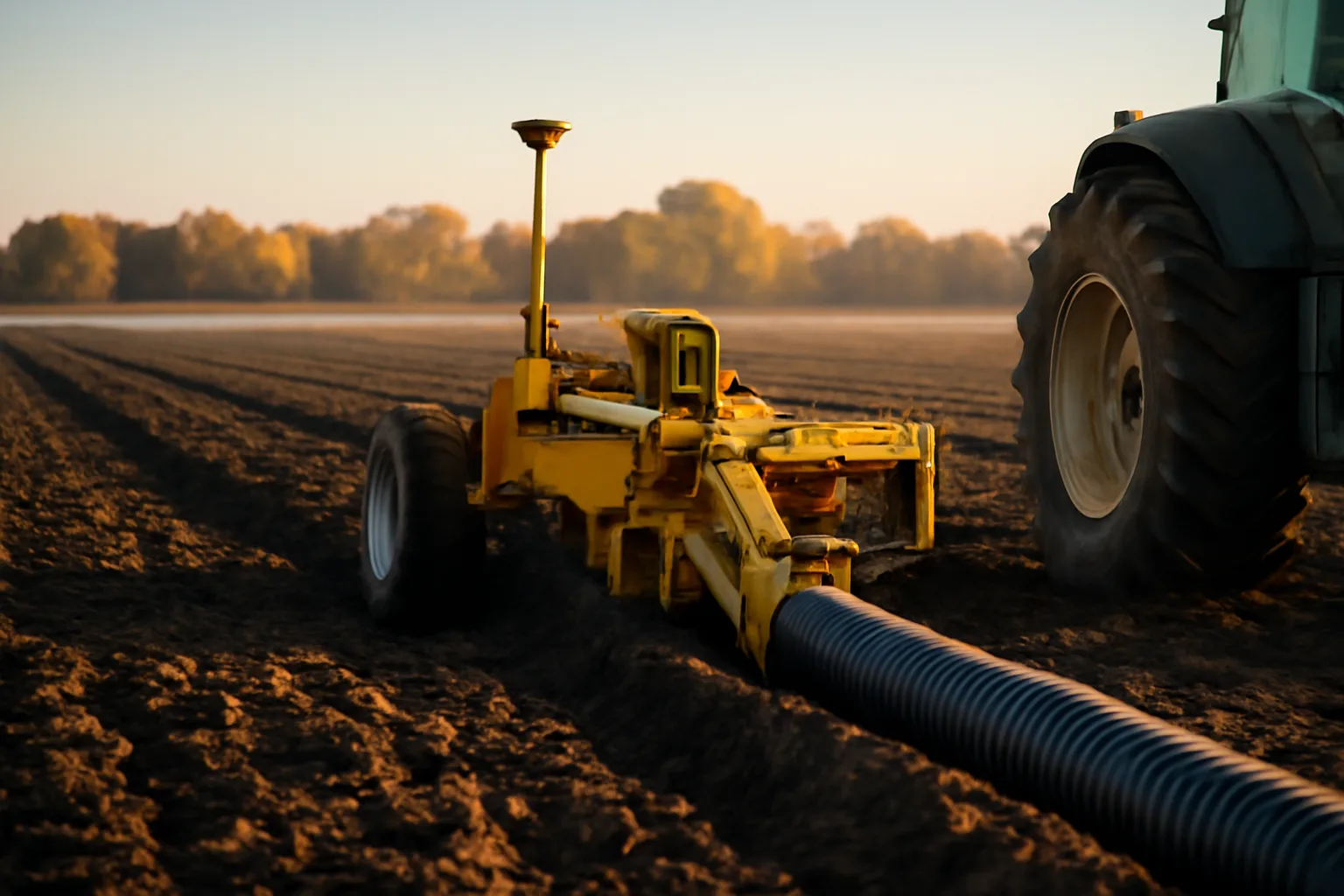
The lower end, $8 to $12 per foot, reflects straightforward agricultural tile work: a GPS-guided tile plow pulling 4-inch corrugated perforated pipe through flat Black Belt or Tennessee Valley farmland. The upper end, $18 to $25 per foot, applies to deeper installs (4 feet or more), larger-diameter pipe (8 inch or 10 inch mains), rocky or sandy soils that need envelope material, or urban and suburban residential drainage where hand-digging or mini-excavator work is involved.
Nobody has published Alabama-specific drainage tile cost studies recently, so these figures come from NRCS cost-share payment schedules and regional contractor surveys from University of Tennessee Extension and Purdue Extension, adjusted for Alabama's labor market [5][6]. Take any single quote with skepticism until you get three bids.
Material costs alone, before any installation labor, break down roughly like this:
| Pipe type | Diameter | Approximate material cost per foot |
|---|---|---|
| Corrugated perforated HDPE | 4 inch | $0.35 to $0.65 |
| Corrugated perforated HDPE | 6 inch | $0.80 to $1.20 |
| Corrugated perforated HDPE | 8 inch | $1.50 to $2.20 |
| Solid HDPE (mains, outlets) | 6 inch | $0.70 to $1.10 |
For a typical Alabama farm field, a one-acre tile grid with 40-foot spacing uses roughly 1,100 linear feet of 4-inch laterals plus a 6-inch main, putting material cost alone at $700 to $1,400 per acre. Total installed cost per acre at common spacing runs $9,000 to $25,000 depending on the contractor and conditions.
EQIP cost-share through NRCS can cover 50 to 75 percent of practice costs for eligible producers, which makes the real out-of-pocket number much lower for qualifying operations [4]. Ask your local NRCS service center for current payment rates in your county.
How long does drainage tile take in Alabama?
For a typical agricultural field project, a professional crew with a GPS tile plow can install 1,000 to 3,000 linear feet per day in good conditions. A 40-acre field with 40-foot lateral spacing needs roughly 43,000 feet of tile. That's a two- to three-week job for one crew, weather permitting.
Smaller residential or yard drainage jobs, the kind where you're running a 4-inch perforated pipe from a soggy backyard corner to a ditch, take one to three days with a mini-excavator or trencher.
Seasonal timing matters more in Alabama than in the northern Corn Belt. The state's wet winters, combined with the heavy clay soils common in the Black Belt region, mean soil conditions for tiling are best in late summer and early fall (August through October) or again in early spring (March to April) when soils are firm enough for equipment but not bone-dry and pipe-shattering hard. Many Alabama contractors book out six to ten weeks during those windows.
Permitting timelines add unpredictability. An ADEM Construction General Permit can be submitted online and typically becomes effective within seven days of a complete, correct submittal [3]. Section 404 nationwide permits are self-certifying for qualifying projects, meaning no waiting period if you've confirmed applicability, but pre-construction notifications to the Corps can add 45 days if your project requires them [2]. County permits range from same-day approval in rural counties to four to six weeks in more bureaucratic metro jurisdictions.
If you're planning around an NRCS EQIP cost-share agreement, budget four to eight months from application to obligation of funds. Applications are ranked and funded in cycles. Missing the signup window means waiting a full year for the next one [4].
What permits does Alabama require for drainage tile installation?
Permit requirements in Alabama break along three axes: project size, receiving water body, and land use type.
For agricultural drainage on your own land, with a tile outlet that discharges to an existing ditch or stream, you often need no state permit at all if the land disturbance is under one acre. NRCS Practice Standard 606 gives technical guidance on spacing, depth, and outlet protection, but it's not a permit. It's a design standard [4].
Once your land disturbance hits one acre or more (measured as total disturbed area, more than the tile trench), ADEM's Construction General Permit kicks in. You register online through the ADEM e-Portal, prepare a SWPPP, and pay a registration fee. Confirm the current fee with ADEM because it updates periodically [3].
If your outlet is in or within 300 feet of a jurisdictional water (a blue-line stream, a mapped wetland), contact the Army Corps Mobile District to determine whether you need a Section 404 permit. Nationwide Permit 40 covers reshaping existing drainage ditches and certain farm drainage activities, but it has acreage limits and preconditions, and verification is the contractor's responsibility [2].
For any project crossing a county or state road right-of-way, contact ALDOT (for state roads) or the county engineer (for county roads). They issue encroachment permits that specify pipe size, cover depth, and backfill compaction requirements.
How does Alabama's agricultural drainage work with NRCS and EQIP?
The USDA Natural Resources Conservation Service is the practical engine behind most farm drainage tile installation in Alabama. Through the Environmental Quality Incentives Program (EQIP), eligible producers can receive cost-share payments for installing subsurface drainage systems that meet NRCS Practice Standard 606 [4].
NRCS national guidance describes Practice Standard 606 (Subsurface Drain) as a practice used to "improve the soil environment for vegetative growth, or to control ground-water flow." Projects must be designed to NRCS engineering standards, which in Alabama means coordinating with your local NRCS field office on design drainage coefficient, pipe sizing, and outlet stability.
Payment rates vary by county and by program year. In recent years, EQIP has covered roughly $400 to $800 per acre for subsurface drainage in Alabama, but confirm current rates with your county NRCS office because they're re-ranked annually. Applications are accepted during continuous signup, with funding decisions typically made in the fall of each year for the following program year.
For producers who don't qualify for EQIP or who want to move faster, the Alabama Soil and Water Conservation Districts sometimes offer state-funded cost-share for conservation practices. Check with your district directly. Funding availability changes year to year [7].
What soil and drainage conditions should Alabama landowners know?
Alabama's soils run the full spectrum, and that variation shapes both the need for tile drainage and the design approach.
The Black Belt (running through Hale, Perry, Marengo, and Wilcox counties) sits on Selma Chalk-derived soils, heavy Vertisols that crack in dry weather and turn to slow-draining clay in wet periods. These soils are chronically wet in winter and spring, and tile drainage pays off fastest here. Lateral spacing of 40 to 60 feet is common, with tile set at 2.5 to 3.5 feet depth.
The Tennessee Valley in north Alabama (Limestone, Madison, Morgan counties) has productive bottomland soils that regularly flood. Here, surface drainage (open ditches) often works alongside or instead of subsurface tile, depending on slope and field layout.
Sand Mountain and the Appalachian foothills have coarser-textured soils with better natural drainage, so tile pays off mainly in low-lying areas or in fields with plow-pan layers that restrict downward water movement.
The Alabama Cooperative Extension System, through Auburn University, publishes soil survey data and drainage guidance for Alabama producers, though their drainage tile technical publications are less developed than those from Corn Belt extension programs [8]. The USDA Web Soil Survey gives soil drainage class and permeability data for any Alabama parcel, which is the logical starting point for any tile design [9].
How does GPS-guided tile plow technology change the Alabama picture?
GPS-guided tile plows have changed what's practical in Alabama over the last decade. A GPS-equipped plow uses real-time kinematic (RTK) GPS to control depth automatically, keeping the tile at a consistent gradient even across rolling terrain. That matters in Alabama's variable topography, where hand-graded tile installations in pre-GPS days sometimes ended up with flat spots or negative grades that cause sediment buildup.
For producers who want to plan their own drainage system before hiring a contractor, a grading and outlet planning kit can clarify where water collects and how the outlet should be positioned. DrainageTilePath offers a Grade + GPS Plow + Outlet Kit at /start for $179 one-time, which covers the planning documentation side of the project. That's worth mentioning once: the planning phase is where most Alabama landowners waste money by skipping it and then discovering mid-install that their outlet is in the wrong spot.
Contractors with GPS plows can often install tile faster and with fewer warranty callbacks than open-trenching methods, because depth control is more consistent. That can offset the higher day rate for GPS-equipped equipment. Ask any contractor bidding your job whether their machine has automatic depth control, and ask to see a sample installation report showing the as-built depth profile.
How do neighboring states compare on drainage tile licensing?
Alabama's contractor licensing threshold of $50,000 is typical for the Southeast. Georgia and Florida both use similar thresholds for contractor licensing, though the specific classifications differ [10][11].
Arkansas, a state with heavier rice and soybean drainage activity than Alabama, has no separate drainage tile license either. It routes through general contractor licensing for commercial work and relies on NRCS standards for agricultural work, much the same as Alabama. See our guide on drainage tile board in Arkansas.
The upper Midwest states (Iowa, Illinois, Indiana) have county drainage districts with taxing authority and their own boards, which is the model that probably inspired the search for a "drainage tile board" in Alabama. Alabama has no equivalent institution. It never developed the county drainage district model that the Corn Belt states built in the late 1800s and early 1900s [12]. That's partly a function of soil type, partly topography, and partly legislative history.
If you're sourcing contractors from neighboring states, check whether their home-state license is recognized in Alabama. ALBGC does not have a formal reciprocity program, so an out-of-state contractor doing work over $50,000 in Alabama needs an Alabama license. Confirm current reciprocity status directly with ALBGC before assuming a Georgia or Tennessee license transfers.
Where to get Alabama-specific drainage tile help
Here's a practical list of who to call, not in any particular priority order:
ALBGC (Alabama Licensing Board for General Contractors): For contractor licensing questions. Phone and online verification available at their official site [1].
ADEM: For stormwater and water quality permits. Their Construction General Permit program is administered online [3].
Army Corps of Engineers, Mobile District: For Section 404 questions. Contact the district regulatory division directly [2].
Your county NRCS service center: For EQIP enrollment, design standards, and cost-share payment schedules. Find your local office through the USDA service center locator [4].
Auburn University Cooperative Extension: For soil drainage publications and local agronomic guidance [8].
Your county engineer: For local permits, road crossings, and county storm system connections. Contact information is on each county's official website.
DrainageTilePath publishes state-by-state guides like this one to help landowners understand the paper path before they spend money. If you want to compare Alabama's framework to a neighboring state, our guides on drainage tile board in Georgia and drainage tile board in Florida cover the Southeast regulatory picture in similar depth.
Frequently asked questions
Do you need a license for drainage tile in Alabama?
For agricultural drainage on your own land under $50,000, no state contractor license is required. If the project exceeds $50,000, or if a contractor is doing the work commercially, an Alabama Licensing Board for General Contractors (ALBGC) license is required. County permits may apply separately for road crossings or connections to public storm systems. Confirm current thresholds with ALBGC directly.
How much does drainage tile cost in Alabama?
Installed drainage tile in Alabama runs roughly $8 to $25 per linear foot, depending on pipe size, depth, and soil conditions. A one-acre tile grid with 40-foot lateral spacing typically costs $9,000 to $25,000 installed. NRCS EQIP cost-share can cover 50 to 75 percent of eligible practice costs for qualifying producers. Material costs for 4-inch HDPE pipe run $0.35 to $0.65 per foot before labor.
How long does drainage tile take in Alabama?
A GPS-guided tile plow crew can install 1,000 to 3,000 linear feet per day in good conditions. A 40-acre field with standard 40-foot lateral spacing takes two to three weeks for one crew. Small residential projects take one to three days. ADEM stormwater permits activate within about seven days of a complete submittal. NRCS EQIP cost-share agreements take four to eight months from application to funded obligation.
Is there a county drainage district system in Alabama like in Iowa or Illinois?
No. Alabama never developed the county drainage district model common in the upper Midwest. There is no taxing authority or elected drainage board at the county level for tile drainage. Oversight is split among the ALBGC for licensed contractors, ADEM for water quality, the Army Corps for Section 404 permits, NRCS for agricultural standards, and individual county engineers for local permits.
What NRCS practice standard applies to drainage tile in Alabama?
NRCS Practice Standard 606 (Subsurface Drain) governs the design, installation, and inspection of drainage tile systems for agricultural use. It covers drainage coefficients, pipe sizing, depth, spacing, and outlet stability. Projects funded through EQIP must meet Practice Standard 606 specifications. Your local NRCS field office provides county-specific design criteria and can review plans before installation begins.
Does Alabama require a stormwater permit for drainage tile installation?
Yes, if land disturbance is one acre or more. ADEM's Construction General Permit applies to any construction activity disturbing one acre or more. You register online through the ADEM e-Portal, prepare a Stormwater Pollution Prevention Plan (SWPPP), and pay a registration fee. Projects under one acre generally don't trigger the permit, but connecting to a jurisdictional water may require separate Army Corps coordination.
Can I install drainage tile myself in Alabama without a contractor?
A landowner can install drainage tile on their own property without a contractor's license, as long as they aren't performing work-for-hire contracts over $50,000. Environmental permits still apply if disturbance reaches one acre or if the outlet affects jurisdictional waters. NRCS can provide technical design assistance through your local service center even if you're doing the work yourself.
Does Alabama EQIP pay for drainage tile installation?
Yes. The USDA Natural Resources Conservation Service administers EQIP in Alabama, and subsurface drainage under Practice Standard 606 is an eligible practice. Cost-share rates in recent years have ranged from $400 to $800 per acre, but payment schedules update annually. Contact your county NRCS service center for current payment rates and the next application signup window in your area.
Do out-of-state drainage contractors need an Alabama license?
Yes, for projects over $50,000. Alabama does not have a formal reciprocity agreement that automatically recognizes other states' contractor licenses. A contractor licensed in Georgia, Tennessee, or Mississippi who takes an Alabama project over the $50,000 threshold needs an ALBGC license for that work. Confirm current reciprocity status directly with the ALBGC before hiring or accepting out-of-state work.
What pipe sizes are typical for Alabama farm drainage?
Four-inch corrugated perforated HDPE is standard for lateral lines, with 6-inch or 8-inch solid HDPE used for collection mains depending on the number of laterals draining into each run. NRCS Practice Standard 606 provides sizing tables based on drainage area and design drainage coefficient. For Black Belt clay soils, 40-foot lateral spacing at 3-foot depth is a common starting design.
How do I find a licensed drainage tile contractor in Alabama?
The ALBGC maintains a public license verification database on their official website where you can search by name or license number. For agricultural tile work under $50,000, licensing isn't required, but it's still worth asking contractors for references from nearby completed projects. Your county NRCS service center often keeps informal lists of contractors familiar with EQIP design and installation standards.
What is the best time of year to install drainage tile in Alabama?
Late summer through fall (August to October) is the most reliable window because soils are firm enough to support equipment without rutting and the pipe is less likely to shift during installation. Early spring (March to April) is a secondary window. Summer installation in wet years risks rutting and delayed field recovery. Many Alabama contractors book out six to ten weeks during peak season.
Does a drainage tile outlet in Alabama need a Section 404 permit?
It depends on where the outlet discharges. If the outlet is in or adjacent to a jurisdictional water of the U.S., including mapped wetlands or blue-line streams, you need to contact the Army Corps of Engineers Mobile District. Nationwide Permit 40 covers certain farm drainage activities but has acreage limits and preconditions. Always verify applicability with the Corps before assuming you qualify for a nationwide permit.
Sources
- U.S. Army Corps of Engineers, Nationwide Permit Program: Nationwide Permit 40 covers certain farm drainage activities in or near waters of the U.S., subject to acreage limits and preconditions
- Alabama Department of Environmental Management, Water Division Stormwater Program: ADEM requires a Construction General Permit for land disturbance of one acre or more during construction activities
- Purdue Extension, The Agronomy Guide (drainage section): Installed agricultural drainage tile costs range from approximately $8 to $25 per linear foot depending on pipe size, depth, and site conditions
- Alabama Cooperative Extension System (Auburn University): Auburn University Cooperative Extension provides soil drainage guidance and agronomic publications for Alabama producers
- USDA Web Soil Survey: Web Soil Survey provides soil drainage class and permeability data for any Alabama parcel
- Georgia Secretary of State, State Licensing Board for Residential and General Contractors: Georgia uses a contractor licensing threshold comparable to Alabama for general contracting work
- Florida Department of Business and Professional Regulation, Construction Industry Licensing: Florida licenses contractors through DBPR with classifications that include excavation and drainage work, used for Southeast comparison
- USDA Economic Research Service, agricultural land and water use reports: The county drainage district model common in the upper Midwest developed in the late 1800s and early 1900s; Alabama did not adopt this institutional structure