Last updated 2026-08-19
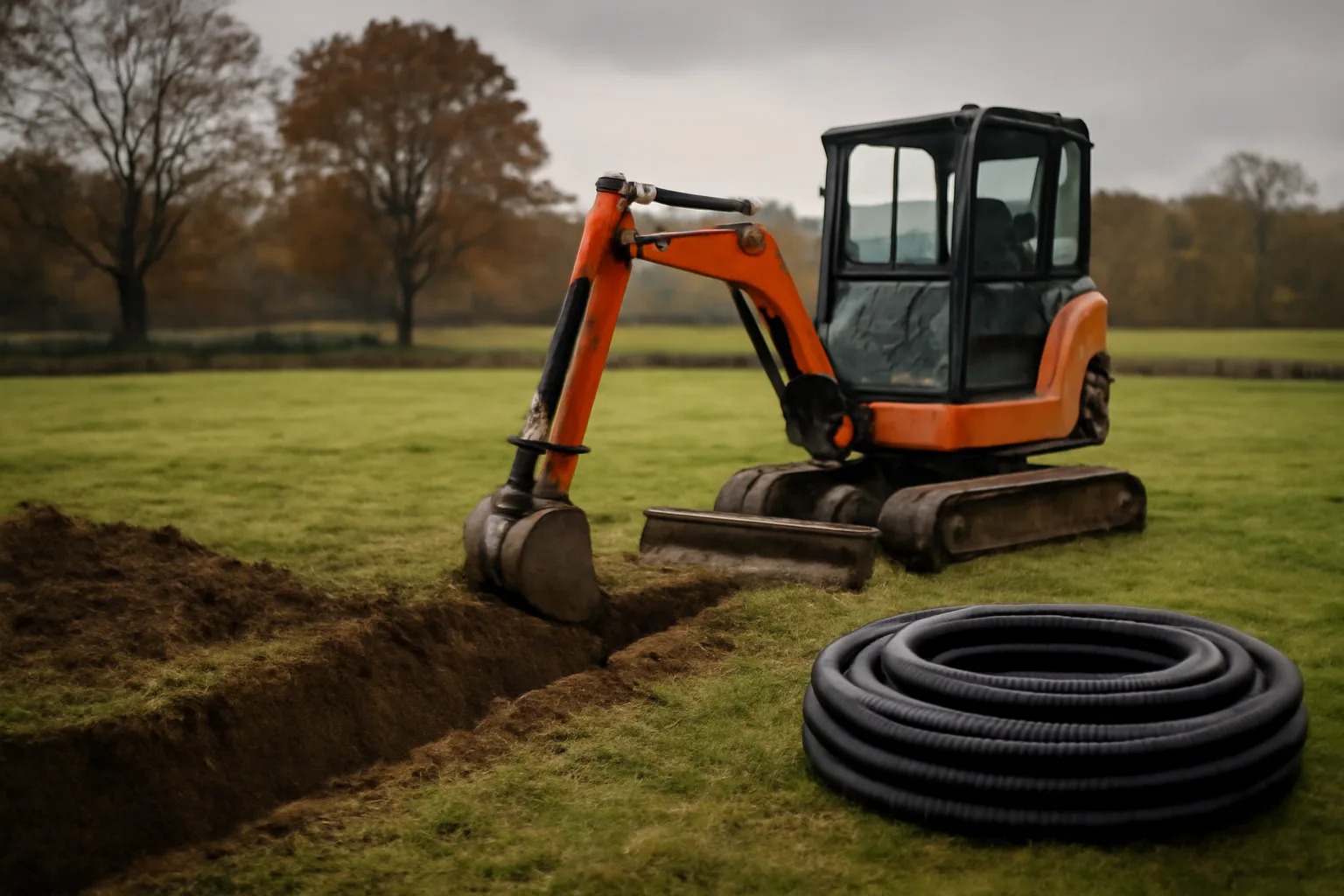
TL;DR
Connecticut does not issue a drainage tile license. Residential drain work usually needs a DCP Home Improvement Contractor registration under Chapter 400. Farm laterals still run through inland wetlands review, 811, and sometimes DEEP stormwater coverage if you disturb 1 acre or more. Confirm current fees and forms with DCP and the town. Dirt is the easy part.
What does starting drainage tile in Connecticut actually involve?
Starting drainage tile in Connecticut means you bury perforated pipe so water leaves a wet field, a barnyard, or a house foundation, and you match that trench to the paper the town and the state already use. That is the whole job. People search this after watching Midwest pattern-tile videos. Those videos are a poor map here.
Connecticut land is short, wet, and watched. Stone walls, shallow ledge, and mapped inland wetlands show up on small parcels. A start path that works in Alabama or Arkansas will skip the commission that can stop a Connecticut outlet. You start with the outlet, not the plow.
Walk the discharge first. If water hits a ditch, stream, wetland, or a neighbor, you are in land-use territory. The Inland Wetlands and Watercourses Act is the statute towns use. The General Assembly wrote the policy in plain language: "The inland wetlands and watercourses of the state of Connecticut are an indispensable and irreplaceable but fragile natural resource with which the citizens of the state have been endowed." [3] That sentence is why a two-hour trench can wait on a monthly commission calendar.
Pull the town wetland map and call the wetlands agent before you price pipe. Call 811 the same week. Do not order a high-horsepower plow for a 40-acre New England farm. That is a Midwest toy. A used chain trencher, a competent excavator operator, and a clean outlet design beat a new plow in this state.
NASS counts Connecticut as a small-farm state in the Census of Agriculture. [15] Most drainage tile connecticut work is a short lateral, a foundation drain, or a repaired main, not a section-line pattern grid. Plan for that scale or you will overbuy steel.
Do you need a license for drainage tile in Connecticut?
No. Connecticut does not issue a standalone drainage tile license. Install drains on a private residence and you generally need a Home Improvement Contractor certificate of registration from the Department of Consumer Protection under Chapter 400 of the General Statutes. [1][12] Farm field tile on agricultural land usually sits outside that statute, but local wetlands review and 811 still apply.
Chapter 400 is blunt. "No person shall hold himself or herself out to be a contractor or salesperson without first obtaining a certificate of registration from the commissioner as provided in this chapter." [1] Home improvement, as defined in section 20-419, is repair, replacement, remodeling, alteration, conversion, modernization, improvement, or addition to a private residence. [2] A perimeter drain on a Cape in Litchfield County fits. Four-inch laterals under a hay field in Lebanon usually do not.
Do not guess your way around DCP. If the customer lives in the building, treat it as home improvement until counsel or the department says otherwise. Confirm the current application, fee, and registration term on the DCP home improvement contractor page. [12] Those numbers move. I will not invent them.
You still need a legal business. Form the LLC or corporation with the Secretary of the State if you want limited liability. [14] Register for state taxes with the Department of Revenue Services if you will collect sales tax or have employees. None of that is a tile license. It is ordinary Connecticut business paper.
Public jobs sit in a different pile. Municipal or state work can trigger bidding rules, insurance minimums, and prevailing wage. That is not the backyard start path. For a contractor-board heavy contrast, read how Arizona and California handle licenses. Connecticut’s hard gate is wetlands, not a tile board.
How much does drainage tile cost in Connecticut?
There is no honest statewide price for drainage tile in Connecticut. Published cents-per-foot series come from Midwest custom rate surveys, not from Hartford. Iowa State University Extension’s Farm Custom Rate Survey is the closest public number set I trust, and it is still Iowa dirt. [13] Rocky soils, short runs, ledge, and wetlands setbacks push a Connecticut job past a flat Corn Belt grid on a per-foot basis.
Material is the easy line. Four-inch single-wall or dual-wall polyethylene is a commodity. Freight into New England and small-quantity buys hurt more than the resin. The expensive part is machine time, hand work around utilities, stone backfill if the trench will not stand, and idle days while a commission posts a legal notice. Bid labor and contingency first, pipe second.
NRCS keeps a national Conservation Practice Standard for subsurface drains (Code 606). [10] When EQIP pays, the Connecticut NRCS office posts a payment schedule for that practice year. [11] Those schedules are cost-share references, not your invoice. Confirm the current year rate with the state NRCS office. Do not copy a blog number.
Residential foundation systems get quoted as a job, not as an acre. No Connecticut agency publishes a median house-drain price. Anyone who hands you one statewide homeowner number is guessing. Get three local excavating bids and compare outlet quality, more than the bottom line.
Waste of money: a new GPS plow spread for a first-year Connecticut route. Also a waste: cheap pipe with no fabric in blowing sands, or no animal guard on an open outlet. Spend on a surveyor or a laser for long grade, and on clean stone at the outfall. Skip vinyl marketing packages from national drain franchises if a local excavator already knows your town’s wetlands agent.
How long does drainage tile take in Connecticut?
The trench is often days. The paper is often weeks to months. A simple house perimeter drain gets cut, bedded, and backfilled in one to three working days if utilities are marked and the outlet is legal. A farm lateral package runs a few days to a couple of weeks of machine time, then stops for weather. Nobody publishes a statewide average calendar for drainage tile connecticut installs, and I will not invent one.
Inland wetlands applications follow the town commission, not your crew calendar. Regular meetings are often monthly. Legal notice and adjacent-owner mailings eat time before a vote. I will not quote a decision deadline. Ask the wetlands agent for the next complete-application cutoff and the next regular meeting. Write those two dates on the bid.
Disturb 1 acre or more and Connecticut’s construction stormwater general permit (the state version of the federal NPDES construction rule) adds a filing clock before earthwork. [5] Confirm current filing steps with DEEP. Do not start the cut while that coverage is still a draft in your email.
Frost and spring saturation shut trenches down. Late summer into early fall is the window when a trench wall is most likely to stand in this climate. April looks tempting and then sloughs. Build weather days into every farm bid.
Utility marks throttle the clock too. You cannot legally start excavation until Call Before You Dig has been notified and the wait in Chapter 293 has run. [8][9] Confirm the current notice window on the CBYD excavator instructions. A crew that mobilizes the morning of the ticket is gambling.
Which permits actually control a Connecticut tile job?
The controlling paper is almost never a "tile permit." It is inland wetlands, excavation notice, and sometimes stormwater. Town inland wetlands commissions regulate activities in and near wetlands and watercourses under Chapter 440. [3] Section 22a-38 defines a regulated activity as any operation within or use of a wetland or watercourse involving removal or deposition of material, or any obstruction, construction, alteration, or pollution of such wetlands or watercourses. [4] Draining to those features can land in that definition. Ask the agent. Do not self-exempt.
Some towns also want a zoning or grading permit for earthwork. That is local. The inland wetlands agent is still the first call on a wet parcel. If the outlet or the trench sits in a federal wetland or below the ordinary high water mark of a water of the United States, the U.S. Army Corps of Engineers New England District regulatory program can apply on top of the town. [16] Corps and town reviews are not substitutes for each other.
Construction stormwater coverage kicks in when earth disturbance hits 1 acre or more, including smaller sites that are part of a larger common plan. [5] A long farm main plus laterals can cross that line even when each trench looks skinny. Measure the disturbed footprint, more than the pipe diameter.
Call Before You Dig is not optional. Chapter 293 requires notice to the central clearinghouse before excavation so utilities get marked. [8][9] Gas, electric, fiber, and municipal water sit in the same shallow zone you want for tile. Hitting a marked line is a bad day. Hitting an unmarked line after you skipped the ticket is worse.
| Job type | DCP home improvement registration | Inland wetlands review | CBYD (811) | DEEP construction stormwater |
|---|---|---|---|---|
| Residential foundation or yard drain | Usually yes [1][2] | If wetlands or a watercourse are affected [4] | Yes [8] | If disturbance is 1 acre or more [5] |
| Farm field laterals on private farmland | Usually no | Often, if the trench or outlet is in or near wetlands [3][4] | Yes [8] | If disturbance is 1 acre or more [5] |
| Work in or below a water of the U.S. | As applicable | Yes, plus possible Corps review [16] | Yes [8] | Often yes |
That table is the real license map. The Colorado start guide leans on different land agencies. Copying another state’s checklist is how people trench first and apply later.
Does farm field tile need the same paper as a house drain?
No. The dirt looks similar. The statutes do not. A house drain on a private residence is home improvement under section 20-419, so DCP registration is the default. [2][12] A subsurface drain under a hay field owned by the farm is usually agricultural earthwork, not a kitchen remodel. You still need a legal business, and you still need land permits if you touch a wetland or watercourse. [4]
Farmers sometimes assume agricultural use wipes out wetlands jurisdiction. It does not. Chapter 440 is resource-based. The commission looks at the wetland and the activity, not at whether you file a Schedule F. Some as-of-right or exemption language exists in municipal regulations for certain farming operations. Those exemptions are narrow and local. Read the town regulations or you will invent a right you do not have.
Outlets are where farm jobs die. Tiling into a mapped watercourse, a roadside ditch that the town claims, or a neighbor’s culvert without written permission is how you buy a lawyer. Get the outlet in writing before you order pipe. A handshake at the fence is not a record.
NRCS practice 606 is written for agricultural land that needs subsurface drainage. [10] Using 606 as a design backbone is smart even if you never take EQIP money. It keeps grade, materials, and outlet protection in a standard someone else already argued about. It is not a permit.
If the same crew does both farm laterals and house perimeter drains, keep the paper piles separate. One unregistered home job can stain the farm route. DCP cares about the residence. The wetlands agent cares about the soil.
What business filings come before the first trench?
File the business before you advertise. Pick an entity and form it with the Connecticut Secretary of the State if you want the liability shield. [14] Confirm current formation fees on the official filing system. I will not quote a fee that may have changed. A trade name filing (the old-style certificate of doing business) still matters if you operate under a name that is not your legal entity name. Ask the town clerk how they want that recorded.
Tax registration sits with the Department of Revenue Services. Sell materials retail, or hire employees, and you will meet DRS early. Workers’ compensation is not optional once you have employees. Unemployment insurance follows payroll. Those are ordinary employer rules, not tile rules, and they still sink new crews that try to pay cash under the table.
Insurance is a bid ticket, not a trophy. General liability plus inland marine on the excavator is the floor I would run. If you trench near foundations, add the conversation about collapse and underground work with your agent. Do not take a homeowner’s word that "the farm policy covers you." Get a certificate or walk.
Home improvement registration, when the job is residential, is the extra Connecticut layer. [1][12] Some towns also want a local contractor registration or a permit bond for work in the right of way if your outlet sits in the town shoulder. Confirm that with the town engineer, not with a Facebook group.
Do not lease a yard or buy a lowboy in month one. Work off a gravel pad you already control. Overhead kills more first-year tile side businesses than pipe prices do. The Alaska start path has a different climate tax. Connecticut’s tax is commissions and insurance.
What do 811 and trench safety require on site?
You notify Call Before You Dig before you excavate, then you wait for marks, then you respect the tolerance zone. Chapter 293 is the statute. [8] The CBYD and PURA pages tell excavators how to ticket a job. [9] Confirm the current statutory wait on those pages before you write it into a contract. Starting early is how people hit gas.
OSHA’s excavation rule is the other hard number. 29 CFR 1926.652 says each employee in an excavation shall be protected from cave-ins by an adequate protective system, with a narrow exception when a competent person finds no cave-in potential and the excavation is less than 5 feet deep. [6] OSHA’s trenching page repeats that 5-foot line for protective systems. [7] Plenty of 4-inch laterals sit shallower than 5 feet. Mains, outlet ditches, and foundation cuts often do not. Treat 5 feet as a stop sign, not a suggestion.
A competent person, in OSHA language, is not your bravest laborer. It is the person who can classify soil and stop the work. Connecticut glacial till can stand like concrete at 8 a.m. and slab at noon after a shower. Slope, shield, or box anything that puts a chest below grade. A cave-in fine is cheaper than a funeral, and neither belongs on a first-year P&L.
Keep spoil back from the edge. Keep the excavator from crowding the wall. Keep water out of the cut if you can. Those are the unglamorous rules that keep a tile crew legal. They also keep the trench on grade, which is the only reason the pipe works.
Hire a one-person owner-operator with a mini excavator and you still own the OSHA duty for your employees. You do not get a magic exemption because the job is "just farm drainage."
Can EQIP or NRCS help pay for drainage tile in Connecticut?
Sometimes. EQIP can cost-share a subsurface drain when a conservation plan supports it and the practice meets NRCS Standard 606. [10][11] Connecticut NRCS, not a blog, decides whether your wet hay ground is an eligible resource concern this program year. Payment rates change. Confirm the current schedule with the state office. I will not invent a per-foot EQIP number.
EQIP is not a startup grant for a tile contractor. It is a contract with a producer. If you are the installer, you work for the farmer and you install to the practice standard the planner wrote. Miss the outlet protection or the specified pipe and the payment can stall. Read the job sheet before you trench.
A 606 system is a designed drain, not a random perforated line pointed downhill. Grade, capacity, materials, rodent guards, and outlet stability are in the standard for a reason. [10] Using that standard on a private job with no cost-share is still a good idea. It gives you a written target when a landowner wants "whatever is cheapest."
Walk into the local NRCS field office with a soils map and an outlet photo, not with a sales pitch. Planners are busy. A clean question about practice eligibility gets a better answer than a speech about your new plow.
Skip EQIP if the landowner needs the water gone before the next hay cut and the ranking cycle will not move that fast. Federal conservation money runs on program years. Wet fields run on rainfall. Those clocks rarely match.
What design and equipment path fits Connecticut land?
Design the outlet, then the main, then the laterals. That order is boring and it prevents most failures. Connecticut soils change in a single pit. Get a texture read. UConn’s soil nutrient analysis lab will not design your drain, but a soil test and a slice with a spade tell you whether you are in silt that smears or sand that blows. [17] NRCS Web Soil Survey plus a hole you actually dug beats a YouTube soil class.
Grade control is the skill. On a 200-foot house run, a laser and a competent operator are enough. On a long main, GPS or a good laser setup earns its keep. If you want a paper pack that walks grade, plow notes, and outlet layout without pretending to be a license, DrainageTilePath sells a $179 one-time Grade + GPS Plow + Outlet Kit. Town wetlands forms still control the job. The kit does not.
Equipment should match ledge and tree roots, not Iowa loess. A compact excavator with a narrow bucket, a chain trencher if you find one that has lived through New England rock, and a plate compactor will do more work here than a 3-point plow you cannot turn around in a 4-acre paddock. Rent for the first three paying jobs. Buying iron to feel official is a first-year tax.
Pipe choice is dual-wall where you need stiffness and clean flushing, single-wall where the budget is ugly and the cover is honest. Sock the pipe in blowing fines. Skip sock in iron ochre country if the sock will clog, and plan for cleanouts instead. Animal guards on every open outlet. That last fitting is cheap. Replacing a chewed main is not.
Do not invent a coefficient and call it engineering. If the watershed is bigger than a backyard, pay someone with a stamp or follow an NRCS design. [10] A flooded neighbor is a lawsuit with a grade rod.
What first year mistakes waste money here?
The expensive mistake is trenching before the wetlands agent talks. The second is treating 811 as optional. The third, and I will not dress it up as a triad of virtues, is buying Midwest iron for New England parcels. Those errors show up as idle payments, crushed utilities, and a plow that lives under a tarp.
Underbidding rock is next. Glacial till and ledge do not care about your per-foot number from an Iowa survey. [13] Put a rock clause in the contract. If you hit refusal, the clock stops and the price changes. Landowners hate that sentence until they see the tooth marks on the bucket.
Skipping a written outlet permission is how farm jobs become trespass. Skipping DCP registration on a house job is how you work unpaid after a complaint. [1][12] I would rather lose a cheap residential bid than explain an unregistered contract to DCP.
Another waste: "filter fabric everywhere" as a superstition, or "no fabric ever" as a macho opposite. Match the sock to the soil. Look at the trench wall. If fines run like coffee, wrap the pipe. If the cut is clean loam over gravel, you may skip it. Nobody has a perfect Connecticut clogging data set. The closest design language sits in the 606 standard and in local NRCS job sheets. [10]
Do not promise a dry basement in a 100-year storm and do not promise a hay field will make June. Tile moves water. It does not repeal groundwater. Write that limit in the proposal. Quiet jobs stay quiet.
How is Connecticut different from other states people copy?
People copy Iowa pattern spacing, then they copy a Sun Belt contractor board. Connecticut is neither. There is no drainage tile board. There is a home improvement statute for houses and a wetlands statute for wet ground. [1][3] That pairing is the state.
California licensing is a contractor-classification problem. Arizona’s license path is the same family of questions. Connecticut’s question is whether your trench is a regulated activity under 22a-38. [4] Study only other states and you will overbuild a license file and underbuild a wetlands narrative.
Acreage is the other difference. Census tables show Connecticut farms run small next to prairie states. [15] A 20-acre wet hay lot does not amortize a $300,000 plow. It amortizes a careful excavator and a good relationship with one town agent. Price your overhead like a specialty earthwork crew, not like a Midwest tile plant.
Season length is shorter than marketing brochures admit. Leaf-off helps you see outlets. Frost shuts the trench. Mud in March is not a personality test, it is a failed compaction test. Plan revenue in a real work season or you will take unsafe winter cuts to make a payment.
Copy design math if it is good. Copy someone else’s permit folklore and you will own the fine.
How do you confirm forms, fees, and local rules before you spend?
Confirm every variable number on the issuing page. DCP posts home improvement registration instructions and the current fee. [12] The town clerk or wetlands agent posts the local application, the legal-notice steps, and the meeting calendar. DEEP posts construction stormwater forms when your disturbed area hits the 1-acre line. [5] CBYD posts how to ticket a locate. [9] NRCS posts the current EQIP payment schedule if you are even in that conversation. [11]
I do not publish a fee in this guide on purpose. Fees change. A stale dollar figure is how readers file a short check and lose a month. If a recap site lists a Connecticut tile license fee, it is already wrong, because the license does not exist.
Write a one-page intake for every job: town, parcel ID, wetland flag, outlet owner, disturbed acres, residential or farm, 811 ticket number, and whether DCP registration applies. That page beats a branded binder. DrainageTilePath is an independent publisher, not a law firm and not a service company. Use this as a map, then read the statute and the town form.
Want the grade and outlet checklist next? Start at /start. Then call the wetlands agent. Then call 811. Then price the rock. That order keeps a first-year Connecticut tile job on the right side of the paper.
Frequently asked questions
Do you need a license for drainage tile in Connecticut?
No standalone drainage tile license exists. Residential work on a private home generally needs a DCP Home Improvement Contractor registration under Chapter 400. Farm laterals usually do not. Confirm the current application and fee with DCP. Wetlands approval and 811 still apply on both job types when the land triggers them.
How much does drainage tile cost in Connecticut?
There is no official statewide price. Midwest custom rate surveys, including Iowa State’s annual Farm Custom Rate Survey, are the closest public per-foot series, and they describe Iowa, not Connecticut. Expect higher installed cost here because of rock, short runs, and wetlands delays. Bid labor and contingency first. Confirm any NRCS cost-share number for the current year.
How long does drainage tile take in Connecticut?
Machine time is often one to several days for a house drain and days to a couple of weeks for farm laterals. Paper takes longer. Inland wetlands calendars are local. Stormwater filings apply at 1 acre of disturbance. 811 has a mandatory wait. Late summer into early fall is the realistic dirt window. Confirm dates with the town and CBYD.
Is agricultural field tile exempt from inland wetlands rules?
Not automatically. Chapter 440 looks at the wetland and the activity. Draining, filling, or altering a wetland or watercourse can be a regulated activity under section 22a-38. Some town regulations carve narrow farming exemptions. Read the local regs and ask the agent before you claim one. A Schedule F does not replace a permit.
Does a foundation drain require DCP registration?
Usually yes, if the building is a private residence and you hold yourself out as the contractor. Section 20-419 defines home improvement broadly. Confirm gray cases with DCP. An unregistered residential contract is how unpaid invoices and guaranty-fund fights start. Farm-only crews should still pause when the customer lives in the structure.
Do I need to call 811 for a shallow 4-inch lateral?
Yes. Chapter 293 ties the duty to excavation, not to pipe diameter. Gas and fiber sit in the same shallow band as field tile. Ticket the job, wait the posted window, and hand-dig in the tolerance zone. A shallow trench is not a free pass. Confirm current notice steps on the CBYD excavator page.
When does DEEP stormwater coverage apply to a tile install?
When earth disturbance reaches 1 acre or more, including phased laterals that are part of one plan, Connecticut’s construction stormwater general permit (aligned with the federal NPDES 1-acre construction trigger) can apply. Measure the disturbed footprint, more than trench width. Confirm current filing steps with DEEP before mobilization.
Can the Army Corps get involved in a Connecticut tile outlet?
Yes, if the work is in a water of the United States or otherwise needs a Section 404 permit. Town inland wetlands approval does not replace Corps review. The New England District regulatory office is the federal contact. Ask early if your outlet is a stream, pond, or mapped wetland, not after the pipe is fused.
Will EQIP pay me as a new tile contractor?
No. EQIP contracts with the producer. You may install a 606 drain the planner specified and the farmer hired you to build. Payment rates and ranking are year-specific. Confirm eligibility and the current schedule with Connecticut NRCS. Do not bid a job that only works if a ranking list breaks your way.
What trench depth triggers OSHA protective systems?
Five feet is the line most crews must plan around. 29 CFR 1926.652 requires a protective system unless a competent person finds no cave-in potential and the excavation is less than 5 feet deep. Mains, pits, and foundation cuts often cross that depth. Slope, shore, or shield. Do not treat farm work as exempt.
Should I buy a GPS tile plow in year one in Connecticut?
I would not. Parcels are small, ledge is common, and wetlands setbacks chop runs. Rent an excavator or a chain trencher for the first paying jobs. Buy iron after you have repeat work in towns you already understand. A new plow is a Midwest scale tool. Overhead will eat a New England first year.
Where do I confirm the current DCP home improvement fee?
On the Department of Consumer Protection home improvement contractor page and the application packet posted there. Fees and terms change. Do not trust a recap blog or this article for a dollar figure. If the job is residential, register before you advertise. If you are unsure whether the job is residential, ask DCP in writing.
Sources
- U.S. EPA, Stormwater Discharges from Construction Activities: Construction activities that disturb one or more acres (or are part of a larger common plan) require NPDES construction stormwater coverage, which Connecticut administers.
- OSHA, 29 CFR 1926.652 Requirements for protective systems: Employees in excavations must have a cave-in protective system except when a competent person finds no cave-in potential and the excavation is less than 5 feet deep.
- OSHA, Trenching and Excavation Safety page: OSHA guidance restates the 5-foot trench protective-system threshold and competent-person duties.
- Connecticut PURA, Call Before You Dig: PURA directs excavators to the Call Before You Dig process before digging in Connecticut.
- Iowa State University Extension, Ag Decision Maker Farm Custom Rate Survey (A3-10): Iowa State publishes the closest widely used public custom rate survey that includes drainage tile installation, which is not a Connecticut price series.
- USDA NASS, 2022 Census of Agriculture Connecticut state tables: The Census of Agriculture publishes official Connecticut farm counts and land-in-farms tables that show a small-farm state, not prairie-scale tile country.
- U.S. Army Corps of Engineers New England District, Regulatory / Permitting: Work in waters of the United States can require a Corps permit from the New England District in addition to town wetlands approval.
- UConn CAHNR, Soil Nutrient Analysis Laboratory: UConn operates the state soil testing lab that landowners use to characterize soils before agronomic or drainage decisions.