Last updated 2026-08-17
TL;DR
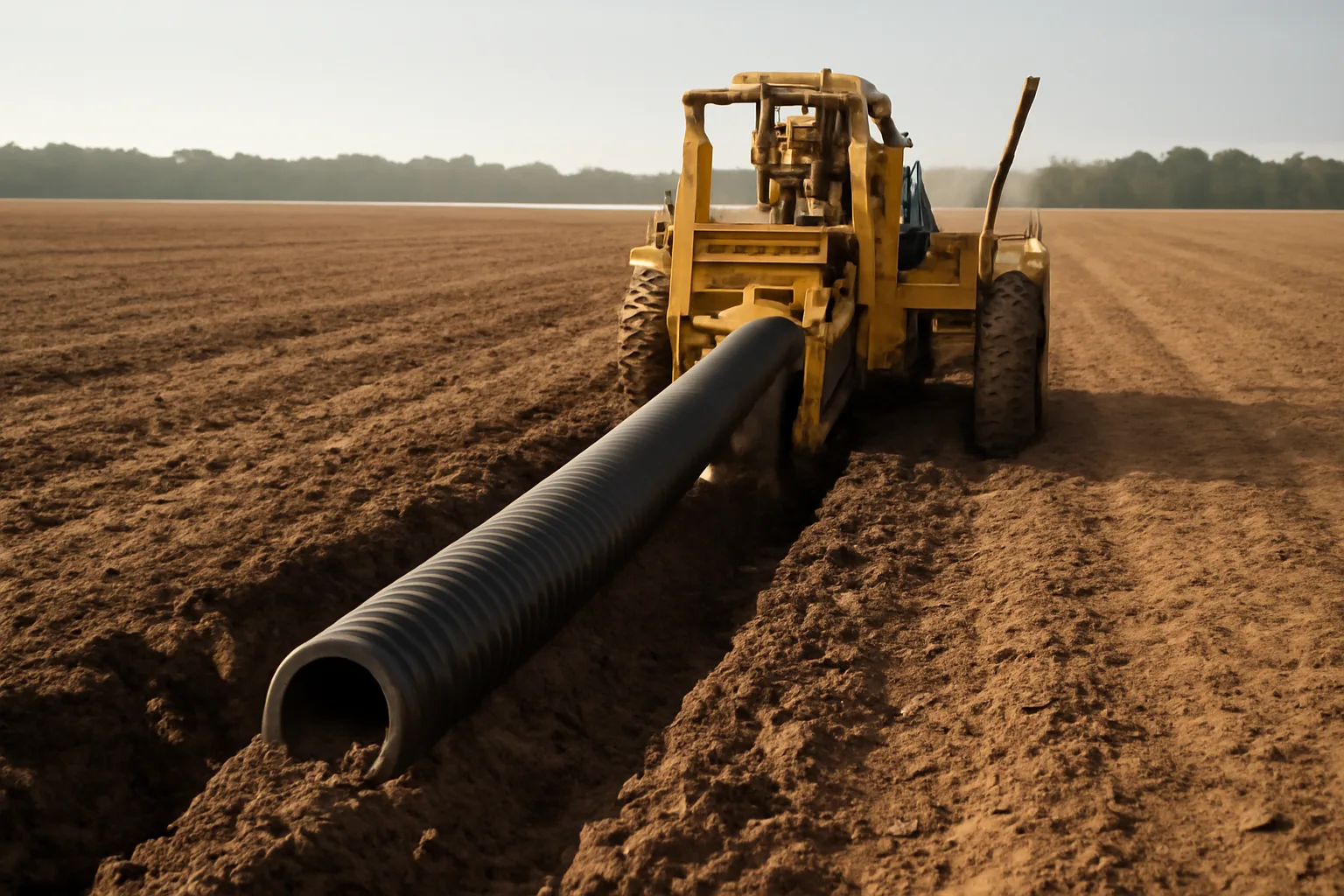
Alabama has no dedicated statewide drainage tile contractor license, but most drainage tile work crosses into excavation and contracting, which the Alabama Licensing Board for General Contractors regulates above $50,000. Installed cost runs roughly $800 to $6,000 per acre depending on soil. A basic field system takes one to three days per field once permits and grades are confirmed.
Do you need a license for drainage tile in Alabama?
Short answer: probably yes, but the license type depends on how you're positioning the work.
Alabama has no standalone "drainage tile" license. What the state does have is the Alabama Licensing Board for General Contractors (ALBGC), which requires any contractor performing construction work over $50,000 to hold a General Contractor license [1]. Below that threshold, local county or municipal licensing rules apply, and they vary quite a bit from Jefferson County to rural Limestone County.
For agricultural drainage tile work specifically, the picture gets more nuanced. If you're working on a farm, draining fields, and the project value stays under $50,000, you may not need a state contractor license at all. Many small drainage tile operators in Alabama work entirely at the county level, pulling a basic business license and satisfying any local excavation requirements. That's legal in a lot of rural counties.
If you plan to work on commercial property, subdivisions, or anything that touches a regulated waterway, the bar rises fast. Work that involves earthmoving near streams, wetlands, or Waters of the State requires a Section 404 permit from the U.S. Army Corps of Engineers and potentially a Section 401 water quality certification from the Alabama Department of Environmental Management (ADEM) [2][3]. Those aren't optional, and skipping them is how operators end up with stop-work orders.
The safest starting position: call the ALBGC directly at (334) 272-5030 and describe your specific scope. They will tell you which license classification fits. Then call your county's probate or revenue office to confirm local licensing. This takes an afternoon and costs nothing. See our full breakdown at drainage tile license in Alabama.
What permits do you need before you dig in Alabama?
Permits in Alabama split along two tracks: state environmental permits and local land-disturbance permits.
On the environmental side, ADEM administers the National Pollutant Discharge Elimination System (NPDES) Construction General Permit for any land disturbance over one acre [3]. Agricultural tillage and drainage operations have a partial exemption under the Clean Water Act, but that exemption narrows the moment you're working for hire on someone else's land or you're disturbing riparian buffers. Confirm with ADEM whether your specific project qualifies before assuming the agricultural exemption covers you.
The Army Corps of Engineers Section 404 permit covers dredge-and-fill activities in waters of the United States [2]. Subsurface drainage tile that stays out of jurisdictional waterways usually doesn't trigger a 404. The moment your outlet pipe discharges into a creek, pond, or ditch that connects to a navigable waterway, you're in 404 territory. Nationwide Permit 27 (Aquatic Habitat Restoration) sometimes covers agricultural drainage improvements, but you need to verify with the Mobile District of the Army Corps.
At the local level, counties with active flood management programs (Baldwin and Mobile Counties are the most active) may require a grading permit or flood-zone review for any earthwork. Check with the county engineer's office before you finalize a bid.
For most interior Alabama farmland drainage tile work, the actual permit list is short: a county business license, ADEM notification if over one disturbed acre, and a Corps check for outlet placement. But "most" is not "all", so check every project individually.
How much does drainage tile cost in Alabama?
Alabama drainage tile costs land in a wide range depending on soil type, tile depth, spacing, and pipe diameter. Based on USDA NRCS cost data and regional contractor pricing published through extension services, installed subsurface drainage runs roughly $800 to $1,800 per acre for lighter agricultural systems and $2,000 to $6,000 per acre or more for deeper, closer-spaced systems on heavy clay soils [4][5].
Here's the breakdown that actually matters for budgeting:
| Cost component | Typical range (per acre) |
|---|---|
| 4-inch corrugated drain tile (perforated HDPE) | $150 to $400 |
| Trenching and installation labor | $400 to $900 |
| Outlet structure and riser | $200 to $600 |
| Grade survey and GPS layout | $100 to $300 |
| Backfill and surface restoration | $100 to $250 |
| Total installed | $950 to $2,450 (light) / up to $6,000 (heavy clay) |
Alabama's Black Belt region, with its Sumter and Selma series soils (some of the heaviest clay in the South), runs on the high end. Sandy loam soils in the Wiregrass area are easier and cheaper to drain.
The USDA NRCS EQIP program often covers 50 to 75 percent of installed drainage costs for eligible producers through the Environmental Quality Incentives Program [6]. That's real money. A $4,000-per-acre project on a 40-acre field totals $160,000. EQIP covering 60 percent drops your out-of-pocket to $64,000. Check with your local NRCS service center before you price any large project, because EQIP availability affects what clients will actually pay.
Material prices move with resin markets, so any quote older than six months deserves a fresh check.
How long does drainage tile take in Alabama?
Installation time depends on field size, tile depth, soil conditions, and equipment. A one-day job for an experienced crew with a GPS-guided tile plow covers eight to fifteen acres in most Alabama soil conditions [5]. Harder clay soils, rocks in the Appalachian foothills, or fields requiring hand-digging around buried utilities slow that down significantly.
For a typical 40-acre field project, expect:
- Grade survey and design: half a day to one day
- Main line trenching and outlet installation: one day
- Lateral installation with a tile plow: one to two days
- Backfill, outlet protection, and cleanup: half a day
Total: three to five days on site for a 40-acre field with a two-person crew and a GPS tile plow.
Permit timing is the wildcard. ADEM's NPDES Construction General Permit requires a Notice of Intent (NOI) submitted at least seven days before ground disturbance, but realistically allow two to four weeks if you need ADEM review [3]. Army Corps nationwide permits are often self-executing if you meet the criteria, but confirming that with the Mobile District takes time. Budget four to eight weeks for permitting on any project that touches a waterway.
Seasonal timing matters too. Alabama's wet season runs November through March. Heavy clay soils in the Black Belt and Coastal Plain become almost impassable for tile plow equipment when saturated. Most operators in Alabama schedule installs from April through October when soil moisture allows equipment without compaction damage.
What equipment do you actually need to start?
The core equipment list for a startup drainage tile operation in Alabama is shorter than most people expect.
A GPS-guided tile plow is the main tool. It lets you install perforated HDPE drain tile at a consistent grade without hand-trenching. Rental or lease options exist through equipment dealers in Huntsville, Montgomery, and Dothan, which makes sense for a first season before you commit to a purchase. A used pull-type tile plow runs $15,000 to $40,000. Newer GPS-integrated units range $50,000 to $100,000 or more.
You need a tractor with enough drawbar pull to operate the plow. In Alabama clay, a 150-horsepower tractor is a realistic minimum for 4-inch tile at 30-inch depth. Underpowered equipment stalls in wet Black Belt soil.
A laser level or GPS grade control system is non-negotiable. Tile installed at the wrong slope either doesn't drain (too flat) or erodes the outlet (too steep). The acceptable grade range for most agricultural drain tile is 0.1 to 0.5 percent, and getting that right by eye is not realistic. DrainageTilePath offers a Grade + GPS Plow + Outlet Kit at $179 one-time that covers the planning and layout component if you want a starting framework before you invest in hardware [see /start].
Beyond that: a pipe trailer or tile cart to carry tile rolls, a backhoe or mini-excavator for outlet structures and mains, and basic hand tools for connections and fittings. Total startup equipment cost for a modest owner-operator setup runs $80,000 to $150,000 if you buy used.
How do you find your first drainage tile clients in Alabama?
The fastest path to first clients is NRCS and FSA offices.
Alabama has dozens of county NRCS service centers [4]. NRCS staff work directly with farmers on drainage system designs, and they maintain lists of contractors who can install approved systems. Getting on that informal referral list costs nothing except showing up, introducing yourself, and demonstrating you understand NRCS practice standards (specifically Practice Standard 606, Subsurface Drain) [7].
Alabama Cooperative Extension System county agents are a second referral channel. Extension agents advise farmers on drainage needs and often know who's looking for a contractor before the farmer does. Contact the Auburn University Extension office in your target county.
Farm Bureau meetings in counties with active row crop production (especially corn and soybean areas in north Alabama and the Tennessee Valley) put you in front of landowners who are actively managing field drainage.
For commercial and residential drainage work, home builders and civil engineers are the primary referral sources. A relationship with one civil engineering firm that does site plans for subdivisions can generate steady sub-contract work.
Be honest about your capacity early. A startup crew that delivers clean, well-graded tile on time gets referrals. Overpromising on schedule in your first season kills the reputation you need to build.
What are the Alabama contractor insurance requirements for drainage work?
Alabama doesn't set a specific statewide insurance minimum for agricultural drainage contractors who work below the ALBGC licensing threshold. But any client worth having will require certificates of insurance before you touch their land.
For licensed General Contractors, the ALBGC sets minimum requirements that include public liability and property damage coverage [1]. The specific minimums are set by license class and project type, so confirm directly with the ALBGC when you apply.
For smaller operations, a general commercial liability policy of $1,000,000 per occurrence and $2,000,000 aggregate is the standard floor that most farm clients and NRCS-funded projects require. If you operate equipment, you need inland marine or contractor's equipment coverage on the tile plow and tractor. Workers' compensation is required in Alabama for employers with five or more employees [8].
Insurance for drainage contractors runs roughly $2,500 to $6,000 per year for a small owner-operator, depending on gross revenue and claims history. That's a real cost to build into your pricing.
How does Alabama's soil and topography affect drainage tile design?
Alabama has five distinct physiographic regions, and each demands a different drainage approach.
The Tennessee Valley (north Alabama) has relatively flat to gently rolling land with silt loam and clay loam soils. Subsurface tile works well here, and the region has the most active agricultural drainage tile market in the state.
The Ridge and Valley and Appalachian Plateau regions in northeast Alabama have steeper slopes, shallow soils, and more rock. Subsurface tile is less common. Surface drainage and waterways dominate. Equipment mobilization in this terrain is harder and slower.
The Piedmont (central Alabama) has red clay soils with moderate slopes. Tile drainage is used but less dominant than in flatter regions. Root intrusion into tile is a real maintenance issue here.
The Black Belt, cutting across central Alabama from Sumter to Barbour Counties, has some of the most demanding soils in the South. Vertisol-class clays shrink and swell dramatically with moisture change. Tile systems here require careful outlet design and often need a mole drainage component. Installation windows are short because the soil either cracks when dry or turns to paste when wet.
The Coastal Plain (south Alabama and the Wiregrass) has sandy soils with good natural drainage in uplands but poorly-drained flatwoods and wetlands in lower areas. Tile drainage is used in the flatwoods for timber and row crops.
Knowing which region you're working in shapes your equipment choices, spacing calculations, and project timelines before you ever set foot on a field.
What is NRCS Practice Standard 606 and why does it matter for Alabama drainage tile contractors?
NRCS Practice Standard 606, Subsurface Drain, is the federal technical standard that governs how USDA-funded agricultural drainage must be designed and installed [7]. If any of your clients receive EQIP cost-share for drainage, their project must comply with Practice Standard 606. That means you need to understand it.
The standard covers minimum pipe diameter (4 inches for laterals), acceptable materials (perforated corrugated polyethylene meeting AASHTO M252 or M294), depth requirements (typically 2.5 to 4 feet for row crops), grade minimums (0.1 percent slope, minimum), outlet requirements (protected, free-draining, above normal water level), and filter sock requirements for fine-textured soils.
Compliance with 606 is how contractors get on NRCS approved-installer lists. It's also a defensible standard if a client ever disputes whether your work was acceptable. Designing to a recognized federal standard protects you legally.
The Auburn University Extension Service publishes drainage guidance for Alabama that follows NRCS standards and accounts for state soil conditions [9]. Reading it before you price your first EQIP project is time well spent.
How do you set prices as a new drainage tile contractor in Alabama?
New contractors consistently underprice, especially on their first few jobs. Here's a pricing framework that holds up.
Start with your true cost per foot of installed tile. Include: equipment depreciation or rental, fuel, tile material, fittings, outlet structure, labor (yours included), insurance allocation, and overhead. In Alabama, that often lands between $2.50 and $5.50 per linear foot for 4-inch tile depending on soil conditions and tile spacing.
Add a margin that accounts for the jobs that go wrong: unexpected rock, a utility conflict, wet weather that eats three extra days. A 20 to 30 percent margin is not excessive for a startup without a history of claims.
For acreage pricing, convert your per-foot cost to per-acre by your planned lateral spacing. 40-foot spacing on a square acre needs about 1,089 linear feet of lateral. At $3.50 per foot, that's $3,800 per acre before main line and outlet costs.
Don't compete on price with established operators in your first year. Compete on responsiveness, design quality, and showing up on time. An experienced contractor who's booked out six months has more jobs than they can handle. A new contractor who answers the phone and delivers professional-grade work takes market share without needing to be the cheapest.
What business structure should you set up for a drainage tile operation in Alabama?
Most small drainage tile operations in Alabama start as a sole proprietorship or single-member LLC. The LLC gives you personal liability protection that a sole prop doesn't, and in Alabama, an LLC costs $200 to file with the Secretary of State [10]. Annual report fees apply. That's the baseline protection worth paying for before you put expensive equipment on anyone's land.
If you plan to take on an ALBGC General Contractor license, the entity you license matters. The license is tied to a qualifying party and an entity, so structure your business before you apply.
You'll need an Employer Identification Number (EIN) from the IRS even if you have no employees, because you'll need it for business banking and some contracts. Get it free at IRS.gov.
Alabama has a privilege license requirement for businesses operating in the state, administered through county probate judges or the Alabama Department of Revenue [11]. Cost varies by county and gross receipts bracket. Confirm your county's specific requirement before you start.
A CPA who works with agricultural contractors is worth paying for at the end of year one. Equipment depreciation, Section 179 deductions, and self-employment tax planning save real money for capital-intensive operations.
Frequently asked questions
Do you need a license for drainage tile in Alabama?
There's no Alabama-specific drainage tile license. If your project value exceeds $50,000, you need an Alabama Licensing Board for General Contractors license in an appropriate classification. Below that threshold, county-level business licensing typically applies. Work near waterways also triggers ADEM and Army Corps environmental review regardless of dollar amount. Call the ALBGC at (334) 272-5030 with your specific scope to confirm what's required.
How much does drainage tile cost in Alabama?
Installed subsurface drainage tile in Alabama costs roughly $800 to $1,800 per acre for lighter agricultural systems on loam soils, and $2,000 to $6,000 per acre or more for heavy clay soils in the Black Belt region. Material, labor, outlet structures, and grade survey are the main cost drivers. USDA EQIP cost-share can cover 50 to 75 percent of eligible project costs for qualifying farmers.
How long does drainage tile take in Alabama?
A typical 40-acre field project takes three to five on-site days with a two-person crew and GPS tile plow. Grade survey takes half a day to one day. Permitting adds time: ADEM's NPDES Notice of Intent requires at least seven days before ground disturbance, but allow two to four weeks. Army Corps coordination for outlet placement near waterways can add several more weeks. April through October is the practical installation season in most Alabama regions.
Does Alabama require an environmental permit for drainage tile installation?
It depends on project size and location. Any land disturbance over one acre requires an ADEM NPDES Construction General Permit. Agricultural drainage has a partial Clean Water Act exemption, but that exemption doesn't apply when you work for hire and disturb riparian areas. Outlets into jurisdictional waterways may require an Army Corps Section 404 permit. Contact ADEM and the Army Corps Mobile District before starting any project near water.
Can I do drainage tile work in Alabama without a General Contractor license?
Yes, in many cases. The ALBGC license threshold is $50,000 project value. Agricultural drainage tile jobs under that amount on private farmland often require only a county business license. But if you're doing commercial grading, subdivision drainage, or any work for a general contractor on a larger project, GC license requirements likely apply. Confirm the threshold and your scope with the ALBGC before you bid.
What does USDA EQIP cover for drainage tile in Alabama?
EQIP (Environmental Quality Incentives Program) covers subsurface drainage installation meeting NRCS Practice Standard 606. Payment rates vary by county and practice, but 50 to 75 percent cost-share is typical for eligible producers. Applications go through your local NRCS service center. Funds are competitive and allocated in annual signup periods, so check with your county NRCS office early in the planning process.
What soils in Alabama are hardest to drain with tile?
The Black Belt region's Vertisol clays (Sumter, Selma, and Houston series soils) are the most challenging. They shrink severely when dry (creating large cracks that can misalign tile) and become nearly impassable for equipment when wet. Installation windows are narrow. These soils often need mole drainage or closer lateral spacing alongside conventional tile. The Alabama Cooperative Extension System at Auburn University has soil-specific guidance for Black Belt drainage.
What insurance do I need for a drainage tile business in Alabama?
A commercial general liability policy of $1,000,000 per occurrence and $2,000,000 aggregate is the standard floor most clients and NRCS contracts require. You also need inland marine or contractor's equipment coverage on your tile plow and tractor. Workers' compensation is required in Alabama for employers with five or more employees. Annual premiums for a small owner-operator typically run $2,500 to $6,000 depending on revenue and claims history.
How do I get on the NRCS approved contractor list in Alabama?
There is no single formal NRCS contractor certification list in Alabama, but county NRCS offices maintain informal referral lists of contractors who understand NRCS Practice Standard 606. Visit your target counties' NRCS service centers, introduce yourself, and demonstrate familiarity with 606 requirements. Completing at least one EQIP-funded project successfully is the fastest way to build that referral relationship.
What business entity should I use for a drainage tile company in Alabama?
A single-member LLC gives you personal liability protection and costs $200 to file with the Alabama Secretary of State. That's worth paying before you put equipment on anyone's land. You'll also need an EIN from the IRS and a county privilege license from your local probate judge or the Alabama Department of Revenue. If you later pursue an ALBGC General Contractor license, your entity structure will need to match the qualifying party listed on the application.
What is the best time of year to install drainage tile in Alabama?
April through October is the practical window in most of Alabama. Heavy clay soils in the Black Belt and Coastal Plain flatwoods are nearly impassable when wet, and Alabama's rainy season runs November through March. Late summer and early fall after crop harvest are ideal: soil is firm, fields are clear, and clients are thinking about next season. Avoid scheduling installs in January and February unless you're working on well-drained sandy soils.
How deep should drainage tile be installed in Alabama?
NRCS Practice Standard 606 specifies a typical depth of 2.5 to 4 feet for agricultural subsurface drains, depending on crop rooting depth, soil permeability, and water table level. In Alabama's heavy clay soils, 3 to 3.5 feet is common. Shallower installation misses the restrictive layer. Deeper installation raises costs without proportional drainage benefit. Your NRCS district office or a licensed agricultural engineer can recommend the right depth for specific field conditions.
How do I price drainage tile jobs as a new contractor in Alabama?
Start with your true cost per linear foot: material, equipment, fuel, labor, insurance, and overhead. In Alabama, that often runs $2.50 to $5.50 per foot for 4-inch tile. Add a 20 to 30 percent margin for field variability and project risk. Convert to per-acre pricing using your planned lateral spacing. Don't try to win jobs by undercutting established operators in year one. Reliability and quality generate referrals faster than a low price.
Sources
- Alabama Licensing Board for General Contractors: Alabama requires a General Contractor license for construction work over $50,000 in value
- U.S. Army Corps of Engineers, Obtain a Permit (Regulatory Program): Section 404 of the Clean Water Act requires a permit for dredge-and-fill activities in waters of the United States, including drainage outlets into jurisdictional waterways
- Alabama Department of Environmental Management, Water Division: ADEM requires an NPDES Construction General Permit for land disturbance over one acre; a Notice of Intent must be submitted at least seven days before ground disturbance
- USDA Natural Resources Conservation Service, Alabama State Office: Installed subsurface agricultural drainage costs vary by region and soil type; EQIP payment schedules reflect local contractor pricing
- Purdue Extension, Subsurface Drainage Installation Rates and Equipment (Publication AY-316): A GPS-guided tile plow with an experienced crew can install eight to fifteen acres of drain tile per day in average soil conditions
- USDA NRCS, Environmental Quality Incentives Program (EQIP): EQIP provides 50 to 75 percent cost-share for eligible conservation practices including subsurface drainage installation for qualifying agricultural producers
- USDA NRCS, Conservation Practice Standards: NRCS Practice Standard 606 specifies minimum pipe diameter of 4 inches for laterals, 0.1 percent minimum grade, depth of 2.5 to 4 feet, and outlet protection requirements for USDA-funded subsurface drainage
- Alabama Department of Labor, Workers' Compensation Division: Workers' compensation coverage is required in Alabama for employers with five or more employees
- Alabama Cooperative Extension System (Auburn University): Auburn University Extension publishes drainage guidance accounting for Alabama soil conditions and NRCS standards
- Alabama Secretary of State, Business Entities Division: Forming an LLC in Alabama costs $200 to file with the Secretary of State
- Alabama Department of Revenue, Business License: Alabama businesses must obtain a privilege license from the county probate judge or Department of Revenue; cost varies by county and gross receipts