Last updated 2026-08-17
TL;DR
Drainage tile in Alabama costs roughly $1 to $3 per linear foot for materials alone, and $4 to $10 per foot installed on farm ground. A 40-acre field system runs $15,000 to $40,000 in phases. Alabama has no drainage-tile-specific contractor license, but work touching wetlands or waterways needs Army Corps and ADEM permits. Budget 2 to 6 weeks for permitting.
How much does drainage tile cost in Alabama?
Drainage tile in Alabama runs $1 to $3 per linear foot for corrugated plastic pipe (HDPE) at the supply counter, and $4 to $10 per linear foot installed once you add machine time, GPS layout, gravel envelope, and outlet work. The spread is wide because soil type, tile depth, and field size move the number hard.
Take a 40-acre row-crop field on Black Belt clay, the heavy Sumter or Demopolis soils common through Marengo, Hale, and Perry counties. That ground can need tile spaced every 40 to 60 feet to drain. At 60-foot spacing on 40 acres, you're installing roughly 29,000 linear feet of lateral plus mains. At $6 per foot installed, that's about $174,000. Most farmers phase it. One 10-acre block at a time.
Smaller residential or lawn jobs (a single French drain or a short run to a ditch) usually run $1,500 to $6,000 total. Landscapers in the Mobile and Huntsville markets quote by equipment days plus materials.
The table below breaks out where the money goes on a mid-scale farm install in Alabama.
| Cost component | Low estimate | High estimate | Notes |
|---|---|---|---|
| 4-inch HDPE corrugated tile (material) | $0.55/ft | $0.90/ft | Unperforated or perforated |
| 6-inch tile (material) | $0.85/ft | $1.40/ft | Collector/main lines |
| Gravel envelope (per ton) | $18 | $34 | Haul distance matters |
| GPS grade and plow machine time | $90/hr | $160/hr | Laser or RTK GPS |
| Outlet structure (per outlet) | $200 | $800 | Concrete or HDPE riser |
| Permitting (wetland review, if triggered) | $0 | $3,000+ | ADEM/Army Corps involvement |
| Total installed (per linear foot) | $4 | $10 | Typical range |
Material prices move with resin costs, and HDPE pipe swung hard between 2021 and 2023 on petrochemical supply pressure. Practice standards and payment schedules for these installs come through USDA NRCS under Conservation Practice Standard 606 [1]. Get current quotes from at least two suppliers before you set a budget.
What drives tile cost up or down on Alabama land?
Soil type is the biggest single lever. Sandy loam in the Tennessee Valley near Limestone and Madison counties drains on its own and may need tile only at problem low spots, so total pipe runs stay short. The heavy Vertisols in the Black Belt crack and swell, need closer spacing, and often demand a gravel envelope to keep clay out of the perforations. That gravel alone adds $0.50 to $1.50 per foot installed.
Depth matters too. Alabama's frost depth is negligible, so tile doesn't go as deep as it does in Iowa or Minnesota. Most Alabama farm tile sits at 24 to 48 inches. Deeper runs mean more machine time per foot, which pushes you toward the high end of the $4 to $10 range.
Field shape is the third factor. GPS-guided plows work fastest and cheapest on long, straight, flat runs. Irregular fields, tree lines, and existing waterways force repositioning and hand-digging around obstacles. Each hour of extra machine time adds $90 to $160.
Field size carries real economy of scale. Contractors mobilize equipment once and spread that cost across the footage. A 5-acre job in rural Sumter County may carry a $1,500 mobilization charge that a 50-acre job barely feels per foot.
The Alabama NRCS office in Montgomery administers EQIP (Environmental Quality Incentives Program) cost-share for farm drainage tile. Payment rates are set annually by state and county, and in recent years EQIP has covered 50% to 75% of practice costs for qualifying producers [2]. That is the single most effective way to cut your out-of-pocket cost on farm tile.
Do you need a license to install drainage tile in Alabama?
Alabama has no standalone drainage tile contractor license. State licensing runs through the Alabama Licensing Board for General Contractors (ALBGC), and any project over $50,000 in total cost requires a General Contractor license under Alabama Code Section 34-8-1 [10]. Below that threshold, residential and light commercial work falls under local county or municipal permit rules, not a state license.
Excavation and grading on private farm ground sits in a gray zone. Farmers installing their own tile on their own land are generally not subject to contractor licensing. Contractors doing tile work for hire on farm projects under $50,000 usually don't need the ALBGC license either, but confirm the current threshold with the board, since it can be adjusted by regulation.
Some counties add a wrinkle. Jefferson County requires a county business license for any contractor operating within the county, whatever the project size. Mobile County has similar rules. Check with the relevant county revenue or probate office before you start.
There's one firm exception. If a drainage project disturbs more than one acre of earth, the Alabama Department of Environmental Management (ADEM) requires a National Pollutant Discharge Elimination System (NPDES) construction general permit and a Stormwater Pollution Prevention Plan (SWPPP) [3]. That's an environmental compliance requirement, not a contractor license, but skipping it carries real fines.
When do you need an Army Corps or ADEM permit for Alabama drainage tile?
This is where Alabama drainage projects most often get derailed. The state sits in the Mobile River Basin, one of the most biodiverse watersheds in North America, and regulators watch any work that could shift wetland hydrology.
Section 404 of the Clean Water Act, run by the U.S. Army Corps of Engineers Mobile District, requires a permit whenever you place fill into waters of the United States, jurisdictional wetlands included [4]. Setting a drainage tile outlet into a ditch, creek, or wetland edge can trigger it. A nationwide permit (NWP) may cover minor impacts, but you confirm that with the Corps before any work starts. The Mobile District office handles Alabama permitting [4].
ADEM also runs a state 401 Water Quality Certification program. Any project that needs a federal Section 404 permit also needs ADEM's 401 certification before the federal permit can issue [3]. Complex projects take longer, but routine 401 reviews are measured in weeks, not days.
For routine farm drainage on upland soils away from wetland boundaries, neither permit is usually required. But "away from wetland boundaries" in Alabama's coastal plain and Black Belt is sometimes closer than farmers expect. A preliminary wetland delineation by a qualified professional costs $500 to $2,000 and can save a project from a stop-work order.
The USDA NRCS Wetland Conservation provisions also govern whether federally assisted projects in Alabama trigger Swampbuster provisions, which can affect EQIP eligibility [5].
How long does drainage tile installation take in Alabama?
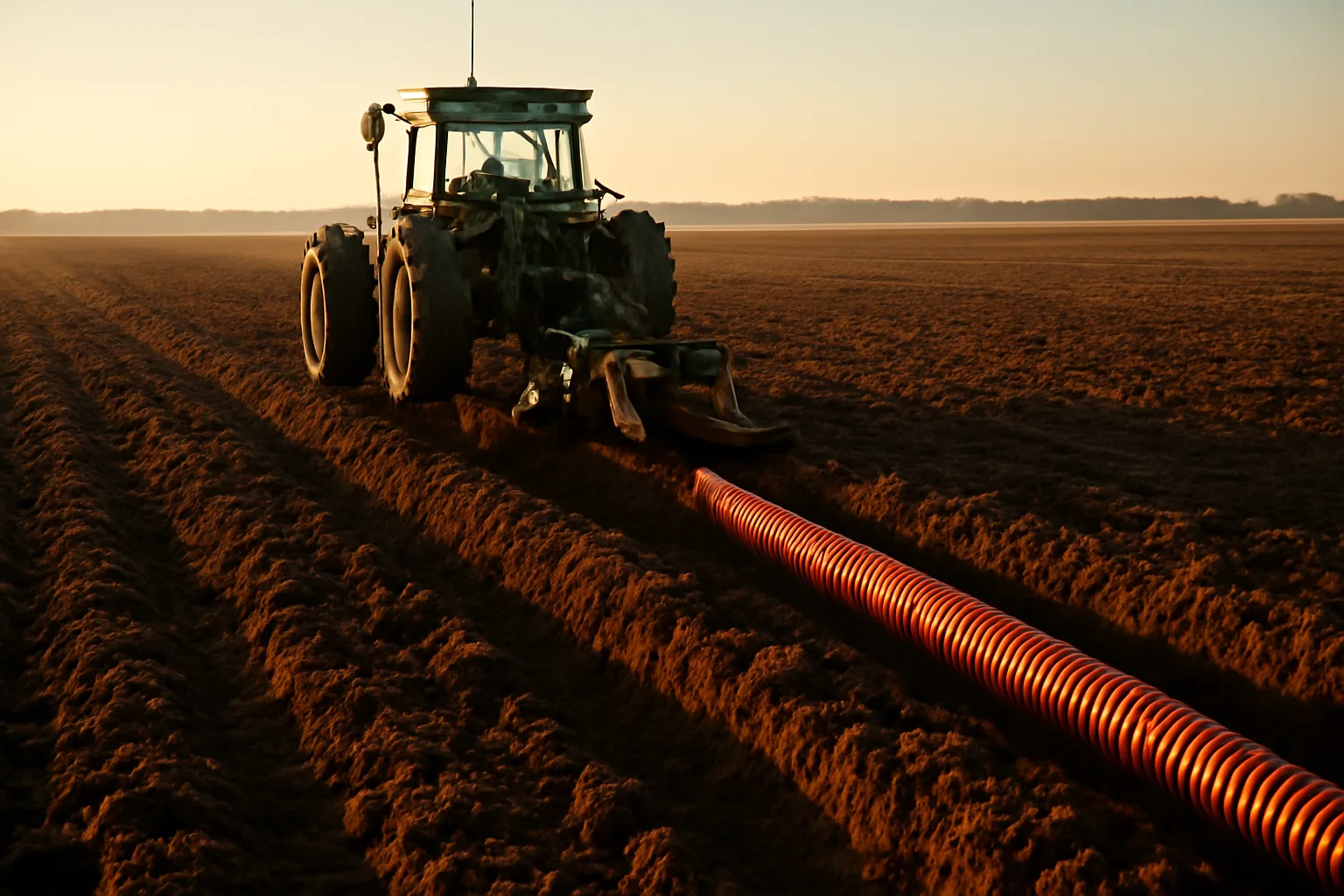
The physical install is faster than people expect. A GPS tile plow on an open field lays 800 to 2,000 linear feet of tile per hour depending on depth and soil [6]. A 10-acre job with 8,000 feet of lateral might take two days of machine time plus a half-day for outlet work.
What actually controls your schedule is permitting. If your project is upland with no wetland involvement and stays under the one-acre NPDES threshold, you may have no required permits and can start as soon as a contractor is scheduled. That's the best case.
If you need an NPDES general permit, ADEM runs a 30-day public notice period minimum [3]. If Section 404 is triggered, a nationwide permit verification from the Corps can take 45 to 60 days. Full individual permits take six months to over a year. Plan around those windows.
Seasonal timing matters here. The Black Belt's shrink-swell clays tile easiest in late summer, when soil moisture is low and the ground is firm. Fall installation sets tile before spring planting. Winter work in wet years is possible but adds bogging risk and rut-repair costs.
How does Alabama compare to neighboring states on drainage tile cost?
Alabama's installed costs ($4 to $10 per foot) sit in the middle of the Southeast range. Georgia, with similar soils and a stronger farm-contractor market in the Flint River region, runs roughly $4 to $9 per foot see [drainage tile cost in georgia]. Florida costs more in many areas because of stricter water management district permitting and shorter contractor availability windows see [drainage tile cost in florida]. Arkansas, with a far more mature tile market in its Delta row-crop region, runs $3.50 to $8 per foot installed, and EQIP rates there often land more favorably because the practice is more established see [drainage tile cost in arkansas].
For contrast outside the South, Illinois and Iowa installed costs run $5 to $12 per foot because of deeper minimum depths (42 to 48 inches in the northern Corn Belt) and higher labor markets. Those states also have far more contractors bidding for the work, which keeps prices honest see [drainage tile cost in illinois].
The practical read: Alabama's costs are reasonable for the Southeast, EQIP cost-share is available and worth applying for, and the permitting burden is manageable on upland farm ground.
What does NRCS EQIP pay for drainage tile in Alabama, and how do you apply?
EQIP (Environmental Quality Incentives Program) is the federal cost-share program that can cut your tile install cost hard. In Alabama, the relevant practice is NRCS Conservation Practice Standard 606, Subsurface Drain [1]. Payment rates vary by county and reset each signup period, so the dollar figure you'd actually get changes annually.
The USDA NRCS Alabama State Office coordinates signups [2]. Applications open during announced signup windows, usually fall or early winter for the next year's projects. Acceptance is competitive: projects are ranked by resource concern and conservation benefit. High-priority Black Belt soils often score well.
The process runs like this. Submit an application at your local NRCS service center, get ranked, receive a contract if funded, install with an approved contractor or your own equipment, then submit documentation for payment. Install before your contract is signed and you lose eligibility.
Here's the math that makes it worth the paperwork. A farmer installing 20,000 feet of lateral tile at $6 per foot spends $120,000 gross. A 60% EQIP payment rate would mean $72,000 in federal cost-share. That's not guaranteed, and actual rates depend on current program rules, but it shows why you apply before you write a check.
If you're doing the grade planning and GPS layout yourself, the DrainageTilePath Grade + GPS Plow + Outlet Kit at $179 one-time [/start] walks you through the layout in a format NRCS field staff can review alongside your application.
What materials are Alabama contractors actually using for drainage tile?
Corrugated HDPE pipe is the standard for new installs across Alabama. It comes perforated (for subsurface collection) and unperforated (for main collector runs and outlets). The common lateral sizes are 4-inch and 6-inch. Mains run 8-inch to 15-inch depending on the drainage area.
Older systems in the Black Belt still have clay tile or concrete tile put in decades ago. They still work where intact, but joints settle over time and root intrusion is common. When farmers extend or repair the old lines, they usually switch to HDPE with a coupling.
Sock filter fabric wrapped around perforated pipe is standard in sandy soils to keep fines from migrating into the pipe. In Black Belt clay, opinions split. Some contractors skip sock because clay particles are large enough not to migrate, and others use it as insurance. Auburn University Extension notes that sock selection should match the specific soil gradation rather than get applied everywhere [6].
Gravel envelope (washed crushed stone, often 3/8-inch pea gravel or similar) is common in heavy clay. A well-designed envelope improves flow into the tile and slows sediment entry. It adds cost, so talk with your NRCS engineer about whether it's warranted for your specific soil.
What is the real first-year cost of drainage tile in Alabama, all-in?
Let's build a realistic first-year number for a mid-scale Alabama operation: a 20-acre Black Belt field being tiled for the first time.
Design and planning: if an engineer or NRCS designs it under EQIP, the design cost may be covered by the program. Self-design using GPS layout tools runs $179 to $500 depending on software.
Permitting: wetland delineation if needed, $500 to $2,000. NPDES permit if over one acre disturbed, application fee under ADEM's schedule (confirm the current fee with ADEM [3]). Army Corps NWP verification if an outlet touches a waterway, no fee for nationwide permits but a 45 to 60-day wait.
Installation: 20 acres at 60-foot spacing, roughly 14,500 feet of lateral plus 2,000 feet of main. At $6 per foot average, that's $98,000. After 60% EQIP cost-share, $39,200 out of pocket.
Outlets and surface inlets: 4 to 6 outlet structures at $300 to $600 each, so $1,200 to $3,600.
Contingency for rock, tree lines, or unexpected wet areas: 10% is a reasonable buffer.
Total first-year all-in estimate (after EQIP, if awarded): $45,000 to $55,000. Without EQIP: $100,000 to $115,000. These are estimates, not quotes, and your site will vary.
How do you find a reputable drainage tile contractor in Alabama?
The Alabama Cooperative Extension System and local NRCS service centers are the most reliable places to start. NRCS keeps a list of contractors who have completed approved tile installs for EQIP projects in each county, and those contractors have already shown they can produce documentation that satisfies federal inspection.
The Alabama Association of Conservation Districts can also point you to contractors active in farm drainage in specific regions [7].
Get at least three bids. Ask each contractor for the GPS or survey data they'll use to set grades, and ask how they handle tile placement when they hit unexpected hardpan or rock. A contractor who can't answer that specifically hasn't done much of this work.
Ask for references on jobs similar in size and soil type to yours. Somebody excellent on sandy loam in the Tennessee Valley may be lost on Vertisol clay in Marengo County. Soil-type experience matters more than total years in business.
Verify ALBGC licensure if the project tops $50,000, and ask for proof of liability insurance before you sign anything [10].
Where to go next if you're planning Alabama drainage tile
Start at your local NRCS service center before you hire anyone. The state office coordinates EQIP signups and can tell you whether your field and soil type qualify for cost-share under Conservation Practice Standard 606 [1]. A conversation with an NRCS engineer costs you nothing and can save you from designing a system that doesn't meet program requirements.
If you're in the permitting review phase, ADEM's Water Division handles 401 certifications and NPDES construction permits [3]. The Army Corps Mobile District handles Section 404 [4].
For the layout and grade planning you can do yourself before contractors arrive, the DrainageTilePath Grade + GPS Plow + Outlet Kit at /start covers the field survey, grade calculation, and outlet spacing in a format you can hand to a contractor or NRCS reviewer.
For a state-by-state cost comparison as you benchmark Alabama against markets where out-of-state contractors might be available, see drainage tile cost in georgia, drainage tile cost in arkansas, drainage tile cost in florida, and drainage tile cost in illinois.
Frequently asked questions
Do you need a license for drainage tile in Alabama?
Alabama has no drainage-tile-specific contractor license. The Alabama Licensing Board for General Contractors requires a license for projects over $50,000 in total cost under Code Section 34-8-1. Farmers installing tile on their own land are generally exempt. Projects disturbing more than one acre need an ADEM NPDES construction permit regardless of who does the work. Confirm current thresholds with ALBGC directly.
How much does drainage tile cost in Alabama?
Materials run $0.55 to $1.40 per linear foot for HDPE pipe depending on diameter. Installed cost, including machine time, gravel, and outlets, runs $4 to $10 per linear foot. A 20-acre farm system might cost $80,000 to $120,000 before EQIP cost-share, and $30,000 to $50,000 after a 60% EQIP payment. Residential French drain jobs run $1,500 to $6,000.
How long does drainage tile installation take in Alabama?
Physical installation on an open field runs 800 to 2,000 feet per hour with a GPS tile plow. A 10-acre project might take two to three days of machine time. The real timeline driver is permitting: no permits means you start when a contractor is available. NPDES permits add 30 days. Section 404 Army Corps nationwide permits add 45 to 60 days minimum.
Does Alabama have EQIP cost-share for drainage tile?
Yes. USDA NRCS Alabama administers EQIP payments under Conservation Practice Standard 606 (Subsurface Drain). Payment rates are set annually by county, and recent rates have covered 50% to 75% of installed cost for qualifying producers. Applications are competitive and must be approved before installation begins. Contact the NRCS Alabama State Office to confirm current signup windows and payment rates.
Does drainage tile in Alabama require an Army Corps permit?
It can. Any outlet placed into waters of the United States, including jurisdictional wetlands or streams, may require a Section 404 permit from the Army Corps Mobile District. Upland installations that don't touch wetland boundaries usually don't. A wetland delineation ($500 to $2,000) before design is the safest way to know. Nationwide permits can cover minor impacts with a 45 to 60-day verification timeline.
What pipe size should I use for Alabama drainage tile?
Four-inch perforated HDPE is standard for lateral collection lines on Alabama fields. Six-inch to eight-inch unperforated pipe handles main collector runs. Residential jobs typically use four-inch. Sizing should be calculated from drainage area, slope, and soil hydraulic conductivity. NRCS engineers use the DRAINMOD model or equivalent for formal design, and your service center can run this at no cost if you're in an EQIP project.
What soils in Alabama need drainage tile most?
The Black Belt Vertisols (Sumter, Demopolis, Oktibbeha series) in central Alabama have severe shrink-swell behavior and very low permeability, making them prime candidates for subsurface tile. Poorly drained Ultisols in the coastal plain also benefit. Sandy loam soils in the Tennessee Valley often drain adequately without tile except at specific low spots. Auburn University Extension has soil-specific drainage guidance for Alabama producers.
Can I install drainage tile myself in Alabama without a contractor?
Yes, on your own farm land. Farmer self-installation is not subject to ALBGC contractor licensing. You'll need a tile plow or trencher and GPS grade equipment. EQIP contracts allow self-installation if you document compliance with the practice standard, though NRCS field staff will inspect before payment. Environmental permits (ADEM, Army Corps) apply to the project regardless of who installs.
How much does a French drain cost in Alabama?
A residential French drain in Alabama runs $1,500 to $6,000 for a typical 50 to 150 linear foot install. Cost varies by trench depth, gravel volume, pipe diameter, and outlet location. Landscaping contractors in Birmingham and Mobile typically quote by day rate plus materials. Larger perimeter drain systems for foundations run $5,000 to $15,000 depending on home size and soil conditions.
Does the NPDES permit requirement apply to farm drainage tile in Alabama?
ADEM requires an NPDES construction general permit for any land-disturbing activity over one acre, drainage tile projects included [3]. Some agricultural activities have exemptions under the general permit, but tile installation using heavy equipment across multiple acres may not qualify. Confirm your specific project with ADEM's Water Division before construction. The permit requires a Stormwater Pollution Prevention Plan.
How deep should drainage tile be installed in Alabama?
Most Alabama farm tile is installed at 24 to 48 inches deep. Frost depth is not a constraint here (it's negligible statewide), so depth decisions come from soil horizon drainage, grade requirements, and outlet elevation. NRCS depth guidance for Alabama is in the Practice Standard 606 document. Deeper tile on heavy clay improves performance but increases machine time and cost.
Where can I find drainage tile contractors in Alabama?
Your local NRCS service center maintains a list of contractors with EQIP-approved installation experience in your county. The Alabama Association of Conservation Districts is another starting point. For any project over $50,000, verify the contractor holds an ALBGC license. Get at least three bids, ask specifically about their experience with your soil type, and request GPS grade documentation as part of their work.
How does drainage tile cost in Alabama compare to Georgia or Arkansas?
Alabama's installed cost of $4 to $10 per foot is close to Georgia ($4 to $9 per foot) and slightly higher than Arkansas ($3.50 to $8 per foot), where a more mature Delta tile market drives competitive pricing. Florida runs higher because of stricter permitting. EQIP payment rates vary by state and year, so net out-of-pocket cost can differ even when gross installed costs are similar.
Sources
- USDA NRCS, Conservation Practice Standards: NRCS Conservation Practice Standard 606 governs EQIP-funded subsurface drain installations including drainage tile
- USDA NRCS, Environmental Quality Incentives Program (EQIP): EQIP is the federal cost-share program that can cover a share of practice installation costs for qualifying producers, with Alabama signups coordinated through the state NRCS office
- Alabama Department of Environmental Management, Water Division: ADEM requires an NPDES construction general permit for land-disturbing activity over one acre and 401 Water Quality Certification for federally permitted projects
- U.S. Army Corps of Engineers Mobile District, Regulatory Program: Section 404 of the Clean Water Act requires an Army Corps permit when placing fill material into waters of the United States including wetlands; nationwide permits may cover minor impacts
- USDA NRCS, Wetlands Conservation: Swampbuster wetland conversion provisions govern whether federally assisted drainage projects affect program eligibility
- Auburn University College of Agriculture / Alabama Cooperative Extension System: Auburn Extension notes sock filter fabric selection should match specific soil gradation; GPS tile plows install 800 to 2,000 linear feet per hour depending on depth and conditions
- Alabama Association of Conservation Districts: Alabama conservation districts connect producers to contractors and technical resources for drainage and conservation projects
- USDA Economic Research Service: Historical and regional context for subsurface drainage installation costs and practice adoption rates in the United States
- USDA NRCS Alabama State Office: NRCS Alabama coordinates EQIP signups and administers cost-share payments for subsurface drain practices in Alabama counties
- Alabama Code Section 34-8-1, General Contractor Licensing: Alabama Code Section 34-8-1 establishes the $50,000 project cost threshold above which a state General Contractor license is required