Last updated 2026-08-19
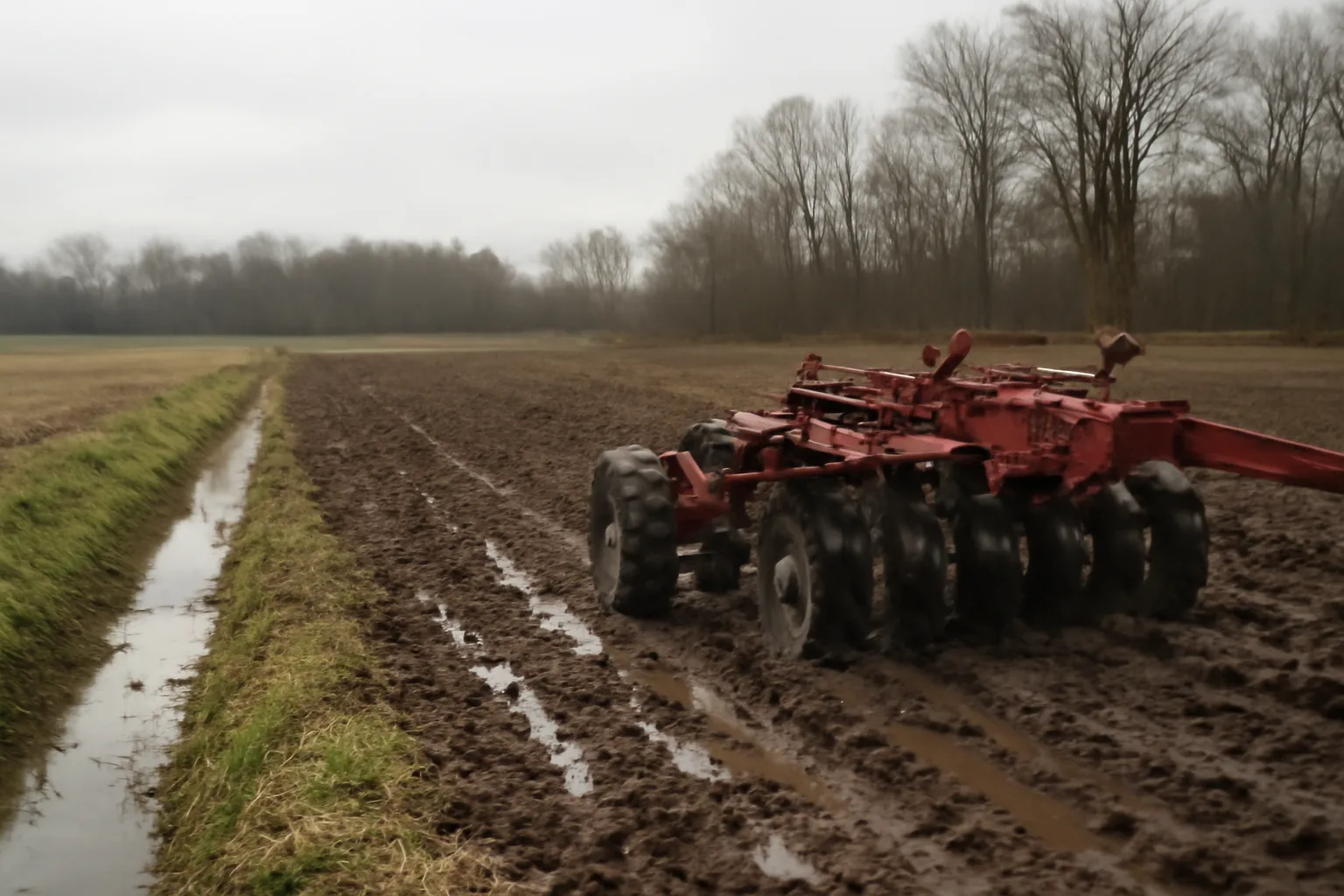
TL;DR
Delaware does not issue a drainage tile license. Paid work still needs a Division of Revenue business license, an 811 locate, and a wetlands and waters check under Title 7 Chapters 66 and 72 plus federal 404 if you hit jurisdictional water. Design around NRCS Practice 606. Dollars and days come from local quotes and agency review. Confirm current fees with the office that owns the form.
Do you need a license for drainage tile in Delaware?
No. Delaware does not issue a drainage tile license, run a tiling board, or give an exam for farm drains. Paid work still needs a Division of Revenue business license under Title 30. Confirm the class and the current fee with Revenue. Tiling your own field is mostly environmental paper, not a trade card.
If someone in a shop tells you to pull a tile license in Dover, they are repeating a national myth. Search drainage tile Delaware and you will hit the same myth in a prettier layout. There is no specialty excavator card for laterals and mains.
You still need ordinary business paper if you get paid. 30 Del. C. Chapter 21 is the general occupational and business license chapter under the Division of Revenue. [4] I will not invent a fee or a processing time. Those move. Confirm the contractor or general business classification and today's amount on the Division of Revenue schedule before you write a check.
Form an LLC or a corporation and that filing is the Division of Corporations. Confirm today's filing cost on their fee page. It is not a drainage approval.
A professional engineer stamp is a different license. 24 Del. C. Chapter 28 governs Delaware PEs. [14] Most on-farm 4-inch laterals never need a stamped set. You may want a PE if a plan goes to DNREC for a channel crossing, a structure in subaqueous lands, or a fight with a tax ditch organization. I would not hire a PE to lay random tile in a prior-converted corn field.
Some towns add a local business license. Check if your shop sits inside city limits. My advice is blunt. Get the state business license and liability insurance before you take the first paid job. Tiling your own ground and selling the work are two stacks of paper.
People mix this up with states that actually license excavators. The path in Alabama and the path in California do not copy Delaware. Read the state you are standing in.
What permits actually stop a Delaware tile job?
Wetlands, subaqueous lands, tax ditch permission, and federal 404 are what stop jobs. A clean prior-converted field that outlets to the farm's own ditch may need no DNREC permit. Mapped tidal wetland, a new bank cut, or fill in waters of the United States changes that. Confirm with the conservation district and DNREC.
7 Del. C. Chapter 66 is the state Wetlands Act. Activities in state-regulated wetlands need a DNREC permit unless an exemption in that chapter applies. [1] Tidal wetlands along the bay and the inland bays are the classic Delaware trap. A mapped wetland on a soils printout is a stop-work flag, not a suggestion.
7 Del. C. Chapter 72 covers subaqueous lands. If your outlet, riprap, or pipe sits on public subaqueous land, you are in a different permit. [2] Confirm the line with DNREC Wetlands and Subaqueous Lands. I would not guess the ordinary high water mark from a truck window.
Federal Clean Water Act section 404 still applies to discharges of dredged or fill material into waters of the United States. EPA explains that the 404(f) exemptions cover certain discharges tied to normal farming that is part of an established, ongoing operation. [10] New pattern tile that drains a jurisdictional wetland is not keep doing what you already do. If you need a nationwide permit, read NWP 40. The 2021 Nationwide Permits state that "The discharge must not cause the loss of greater than 1/2-acre of waters of the United States." [9]
Delaware also runs tax ditches under 7 Del. C. Chapter 41. [3] A lot of farm water already lives in those channels. Cut a new outlet into a tax ditch without talking to the ditch organization and you pick a fight you will lose.
Sediment and stormwater rules live in 7 DE Admin. Code 5101. [7] Agricultural land management is not treated like a housing pad. Confirm any exemption with the conservation district in the county where the field sits. Do not take a blog's word for it.
| Paper | Who owns it | Needed on a typical paid farm job? |
|---|---|---|
| Delaware drainage tile license | Does not exist | No |
| Division of Revenue business license | Division of Revenue (Title 30) | Yes if you engage in business |
| 811 ticket | Miss Utility of Delmarva (26 Del. C. c. 8) | Yes before you excavate |
| Chapter 66 wetlands permit | DNREC | Only if the activity is in state wetlands |
| Chapter 72 subaqueous permit | DNREC | Only if you work public subaqueous lands |
| 404 / NWP 40 | USACE and EPA | Only if you discharge fill in waters of the U.S. |
| Tax ditch permission | Tax ditch organization (7 Del. C. c. 41) | If the outlet cuts their channel |
Call the district first. Then DNREC if the outlet or the wet signature looks tidal or channelward. Then USACE Philadelphia District if you are filling waters of the United States.
How much does drainage tile cost in Delaware?
There is no official Delaware drainage tile cost schedule. Price the job from local quotes: pipe, outlets, machine time, GPS grade, locates, and any permit. Midwest custom-rate surveys such as Iowa State's A3-10 are the closest public numbers, and they are not Delmarva bids. Get three quotes that walked the outlet.
Anyone handing you one statewide dollar figure for drainage tile Delaware work is inventing a market. Iowa State University Extension's Farm Custom Rate Survey (AgDM File A3-10) is the public custom-rate series I actually use as a band. [12] Those are Iowa machine rates. Coastal labor, short fields, and mobilization change the number on the peninsula.
Your real stack is corrugated pipe and fittings, outlets and rock, plow or trencher time, GPS grade, a simple design, locates, and DNREC or Corps paper if the site trips those rules. Small Delaware fields make mobilization a bigger share of the bid than it is on a 160-acre Midwest block. A 1,200-foot job can lose money if the machine trails the length of the state for it.
I get three written quotes. I throw out the one that never walked the outlet. Cheap coil that kinks in a sandy cut is a waste of money. So is a beautiful lateral system that dumps into a crumbling bank.
Pattern tile on tight spacing costs more per acre than a couple of random lines to a wet hole. Drainage water management structures cost more than a rodent guard and an armored outlet. If a salesman cannot separate those line items, walk away.
Confirm current material prices with suppliers. Resin moves. I will not lock an old catalog number into this page and pretend it is still true. Pay for the outlet like it is the system, because it is the part that fails first.
How long does drainage tile take in Delaware?
The plow days are short. Paper and weather are not. A simple upland job can be installed in a few days once the machine is on site. DNREC or Corps review, if triggered, runs on the agency's clock. Confirm current times with that office. I give no approval or timing guarantees.
People remember the afternoon the plow crossed the headland. They forget the week the ticket sat with Miss Utility, the month a wetland file sat with DNREC, and the winter the coastal plain would not hold a grade.
You wait on 811. 26 Del. C. Chapter 8 requires notice to the notification center before you excavate. [5] Confirm today's wait window and ticket life with Miss Utility of Delmarva. Then you wait on soil. These fields can stay too wet to hold a plow grade after a wet fall.
Crop timing matters. Most farm tile here goes in after harvest and before the profile saturates. Miss that window and you are looking at the next year, not the next week.
If the only wet spot is a pothole with no wetland flag and the outlet is the farm's own ditch, design plus install can be short. If the outlet is a tax ditch bank or a tidal fringe, plan the season around the permit, not around the plow. Nobody has good public data on median Delaware tile calendars. The closest honest statement is that dirt time is days and triggered agency review is not.
Who do you call first in Kent, New Castle, or Sussex?
Call the conservation district in Kent, New Castle, or Sussex first, with a parcel ID and a sketch. Then NRCS if the farm is in USDA programs. Then DNREC if the site looks tidal or channelward. USACE Philadelphia District is the federal 404 shop when you need one.
Delaware has three counties and three conservation districts. Those districts already talk to NRCS and already see farm earthwork. They are also the local face of sediment and stormwater questions under 7 DE Admin. Code 5101. [7]
NRCS holds the Field Office Technical Guide and the wetland conservation compliance process for USDA participants. [11] If the farm takes any USDA payment, I would not design an outlet until someone has looked at the wetland determination.
DNREC owns tidal wetlands, subaqueous lands, and a lot of the tax ditch world under Chapters 66, 72, and 41. [1] [2] [3] Here is my rule: I call the conservation district before I order coil. Pipe is easy to buy. A stopped job is not.
Comparing paper across states? Alaska's start path and Arizona's start path will not help you read a Sussex tax ditch map. They will remind you that drainage tile is not one national permit.
What wetlands rules apply before you plow a line in Delaware?
Screen for state tidal wetlands (Chapter 66), public subaqueous lands (Chapter 72), federal waters (404), and Swampbuster if the farm takes USDA money. Do this before you design. Prior converted cropland is not a free pass into a tidal marsh. Site calls are site-specific.
State tidal wetlands sit under 7 Del. C. Chapter 66. [1] Public subaqueous lands sit under Chapter 72. [2] Federal waters sit under 404. [10] USDA participants also sit under the Wetland Conservation provisions, often called Swampbuster. Converting a wetland can cost USDA eligibility. [11]
Prior converted cropland can change the federal 404 and Swampbuster analysis. It does not let you fill a tidal wetland because the corn drill has been there. Farmed wetland and wet signatures still deserve a real look.
I pull soils and I walk the outlet. Then I ask the landowner for any NRCS wetland determination they already have. If they have never asked, and they take USDA money, I send them to FSA and NRCS before I bid a system that could be called conversion.
The honest hedge: parcel-level wetland calls are site-specific. Nobody has a public layer that replaces a determination. Mapped hydric soils are a flag. They are not the permit.
Need NWP coverage? Stay inside the 1/2-acre loss cap in the 2021 Nationwide Permits or apply for something more specific. [9] Going over that cap on a farm job is how a simple plow day becomes a year of Corps paper.
How should you design drainage tile so the trench matches the paper?
Build to NRCS Practice 606 thinking even if you never file a cost-share job. Set grade, capacity, material, and a stable outlet above normal water. Map the as-built. GPS grade control earns its keep on flat coastal plain. Add fancy water-control structures only if someone will actually manage them.
NRCS Conservation Practice Standard Subsurface Drain (Code 606) is the document most careful contractors still build around. Iowa State Extension's custom-rate and drainage files are the public numbers and the design habits I can actually point you to, even though they are Midwest paper. [12] Grade, capacity, sock or envelope where the sand needs it, and a stable outlet are the guts of a system that still runs in year five.
I set outlet invert above normal water in the receiving ditch so the line can run. I armor the bank. I put on an animal guard. Outlets fail first in this climate. Ice, muskrats, and cattle paths take them out.
GPS grade control is not a luxury on long laterals in flat ground. A belly in the line silts. A hump holds water. Either way you bought pipe that does not work.
Want a compact grade, GPS plow, and outlet checklist? DrainageTilePath publishes a $179 one-time Grade + GPS Plow + Outlet Kit at /start. You do not need it to follow this article. The statutes above stand on their own.
Skip control structures unless the plan is drainage water management or a water-quality project somebody will operate. They are the right tool for some poultry-grain rotations. They are a waste if the boards will sit open all year.
Map the as-built. Future deep ripping and a new poultry house lane will thank you.
What business paper do you need in the first year?
For paid work: EIN, a Delaware business license, insurance, and workers' compensation if you have employees. Confirm current license and entity fees with Revenue and Corporations. Delaware has no sales tax. Gross receipts tax may still apply. Keep 811 tickets and a written scope.
Get an EIN from IRS. Decide if you need an entity. File whatever the Division of Corporations asks if you go that route, and confirm the fee. Get the Division of Revenue business license under Title 30. [4] Do not copy a Maryland sales-tax habit across the line.
Have employees? Workers' compensation is 19 Del. C. Chapter 23. [13] Confirm coverage with your carrier. Sole proprietors without employees sit in a different spot. I still buy general liability before I take a neighbor's check.
Write a one-page scope: field, footage, depth, outlet, what happens if you hit wetland flags or a utility. Keep 811 tickets. Keep photos of the outlet.
No quota. No state-issued tile bonding program I can point to. Confirm any county or town add-ons where your shop sits. Arkansas and Colorado stack this paper differently. Use those guides when you work those states. Not as a Delaware checklist.
Do you have to call 811 before you tile in Delaware?
Yes. 26 Del. C. Chapter 8 requires notice to the notification center before you excavate. Use Miss Utility of Delmarva and wait until the ticket is clear. Farms hide power, gas, fiber, and poultry-house lines. Open pits at outlets also trigger OSHA excavation rules.
Chapter 8 is the underground utility damage prevention law. [5] Notice goes to the approved notification center. Confirm the current wait and the ticket life with Miss Utility of Delmarva. I do not move a plow until the ticket is clear or marked.
Farms are not empty. A tile plow will cut a line you cannot see along a lane, a bin, or a house pad.
Open excavations at outlets and junction pits are a different risk. OSHA 29 CFR 1926.652 says: "Each employee in an excavation shall be protected from cave-ins by an adequate protective system designed in accordance with paragraph (b) or (c) of this section except when:" the excavation meets an exception in that section, including many cuts under 5 feet after a competent person looks at the soil. [8] Read the exceptions. Do not put a person in an unmarked hole next to a ditch bank because the lateral was plowed.
How do nutrient management rules touch a tile outlet?
Chapter 22 does not license tile installers. It does sit on many poultry and grain farms you will work. Tell the nutrient management planner when drainage changes. A free-flowing tile outlet is not a water-quality credit. Confirm applicator certification with the Nutrient Management Program if you also handle litter.
3 Del. C. Chapter 22 is Delaware's Nutrient Management Law. [6] It certifies certain planners and handlers and it sits on animal agriculture. Installing tile does not, by itself, make you a nutrient applicator.
A new tile network can move nitrate to the ditch faster. If the farm already has a nutrient management plan, the planner should know the drainage changed. I would tell them before the next litter spread.
I would not sell tile as a water-quality practice unless the design includes management that a plan can actually use. A free-flowing outlet to a tax ditch is drainage. It is not a credit.
Confirm current certification rules with the Delaware Nutrient Management Program at the Department of Agriculture if your work includes litter handling. That is their board, not a tile board.
Should you start on your own ground or bid other farms?
Start on land you control. Learn grade and outlets where a mistake is yours. Then bid neighbors with honest mobilization. Delaware is a small state. Tax ditch boards and farmers remember a bad bank cut. Get written permission for every outlet you do not own.
Delaware fields are small and neighbors talk. One blown outlet in a tax ditch bank will follow you. Learn grade, sand lenses, and how a winter treats an unprotected pipe end on your own wet hole first. [3]
Then bid. Price mobilization honestly. A short footage job dies if the plow spends more time on the trailer than in the cut.
Work out of state later and you read that state's guide. License talk in Arizona is not Delaware talk. Neither is California licensing.
Where do new Delaware tile jobs waste money?
The money pit is a pretty lateral system with a weak outlet, or a plow that starts before the wetland screen. Rent the machine until the book of work is real. Keep a paper folder. Confirm every fee with the board that owns the form. This site is a publisher, not your lawyer.
Tight pattern tile on a sandy ridge that already drains is how you spend coil for no yield. Starting dirt work before the Chapter 66 and 404 screen is how you park a machine. [1] [10] Bargain pipe with crushed coils is how you buy a re-dig.
Skip the giant trencher until you have work. Subcontract the plow. Buy coil as the job needs it.
Keep the folder: soils, wetland notes, 811 numbers, design grades, outlet photos, landowner sign-off. If NRCS ever cost-shares a related practice, that folder is the job.
DrainageTilePath is an independent publisher, not a law firm and not a contractor. For a simple grade and outlet kit you can start at /start. The statutes and district offices above are the path. Confirm every fee and every review clock with the board that owns the form.
Frequently asked questions
Do you need a license for drainage tile in Delaware?
No standalone drainage tile license exists. If you get paid, you still need a Delaware business license from the Division of Revenue under Title 30. Confirm the current class and fee with Revenue. A PE stamp under 24 Del. C. Chapter 28 is only an issue if you are stamping plans, which most farm laterals never need.
How much does drainage tile cost in Delaware?
There is no state price list. Bid pipe, outlets, machine time, GPS grade, locates, and any permit from local contractors. Iowa State Extension's Farm Custom Rate Survey (AgDM A3-10) is the closest public custom-rate series, and it is Iowa data, not Delmarva data. I would not hire a quote that never walked the outlet.
How long does drainage tile take in Delaware?
Dirt work on a clean field is often a few days after the machine arrives. 811 wait, weather, and any DNREC or Corps review run the real calendar. I will not invent an agency processing time. Confirm current review clocks with the office that has the file. No approval or timing guarantees.
Does DNREC permit every farm tile line?
No. A prior-converted field that stays out of state wetlands and public subaqueous lands may need no DNREC permit. Chapter 66 and Chapter 72 still apply if you work those waters. Confirm with the county conservation district and DNREC Wetlands and Subaqueous Lands before you assume an exemption.
Can NRCS pay for new pattern tile in Delaware?
Sometimes a related conservation practice is cost-shared. New drainage that converts a wetland is a Swampbuster problem, not a payment. Ask the local NRCS office and read the current EQIP practice list for Delaware. I would not bid a job on a hoped-for payment.
Is prior converted cropland free of all wetland rules?
No. It can change the federal 404 and Swampbuster analysis. It does not authorize work in Delaware tidal wetlands under Chapter 66, and it does not replace a site look at the outlet. Treat hydric soils and wet signatures as flags until NRCS or DNREC says otherwise.
Do I need a professional engineer to design farm tile?
Usually no for simple on-farm laterals. 24 Del. C. Chapter 28 is the PE statute if you are offering stamped engineering. I would bring a PE in for a channel structure, a subaqueous landing, or a dispute with a tax ditch organization. Confirm with the PE board if your scope looks like engineering.
Does Delaware charge sales tax on drainage pipe?
Delaware has no state sales tax. You may still owe gross receipts tax on business receipts. Confirm current GRT rules and the business license class with the Division of Revenue under Title 30. Do not copy a Maryland sales-tax habit across the state line.
What size tile is typical on Delmarva grain ground?
Four-inch laterals into larger mains are the usual farm pattern, with the main sized to the acreage and the drainage coefficient you actually designed. That is practice, not a Delaware statute. Size the outlet and the main first. Undersized mains are how a pretty lateral map still ponds.
Can I outlet tile into a tax ditch?
Only with permission from the tax ditch organization. 7 Del. C. Chapter 41 is the tax ditch chapter. A lot of Delaware farm water already lives in those channels. Cutting a bank without talking to the ditch managers is how you buy a repair bill and a bad name.
What happens if I convert a wetland and I take USDA payments?
You can lose USDA program eligibility under the Wetland Conservation provisions (Swampbuster). Get an NRCS wetland determination before you design an outlet on a farm that takes federal payments. State Chapter 66 and federal 404 can still apply even if USDA is not in the picture.
Do I need workers' compensation to install tile?
If you have employees, 19 Del. C. Chapter 23 is the workers' compensation chapter. Confirm coverage with your carrier. A sole proprietor with no employees sits in a different spot. I still carry general liability before I take a paid job, because a cut utility or a failed bank is expensive either way.
Is a chain trencher or a tile plow better in Sussex sand?
A plow is faster in long, clean laterals if grade control is real. A chain trencher or open cut is still how many outlets, crossings, and tight junctions get built. Sandy lenses can slough. I would not buy either machine until the book of work pays for it. Rent first.
Where do I confirm current state fees?
Division of Revenue for the business license, Division of Corporations for entity filings, DNREC Wetlands and Subaqueous Lands for permit applications, and the PE board if you stamp plans. I do not publish a fee that can change. Confirm with the office that owns the form before you pay.
Sources
- Delaware Code Title 7 Chapter 66 (Wetlands): Activities in Delaware state-regulated wetlands require a DNREC permit unless a chapter exemption applies
- Delaware Code Title 7 Chapter 72 (Subaqueous Lands): Work on public subaqueous lands is a separate DNREC permit path from upland farm laterals
- Delaware Code Title 7 Chapter 41 (Tax Ditches): Delaware tax ditch organizations manage many constructed drainage channels that farm outlets use
- Delaware Code Title 30 Chapter 21 (occupational and business licenses): Delaware requires a state occupational or business license to engage in business, administered by the Division of Revenue
- Delaware Code Title 26 Chapter 8 (Underground Utility Damage Prevention): Excavators must notify the approved notification center before excavating in Delaware
- Delaware Code Title 3 Chapter 22 (Nutrient Management): Delaware nutrient management certification applies to certain planners and handlers, not to tile installation itself
- 7 DE Admin. Code 5101 Sediment and Stormwater Regulations: Delaware sediment and stormwater rules are the statewide earth-disturbance regulations conservation districts apply
- OSHA 29 CFR 1926.652 Requirements for protective systems: Employees in excavations must have cave-in protection except where 1926.652 exceptions apply, including many cuts under 5 feet after a competent person inspection
- U.S. Army Corps of Engineers, Reissuance and Modification of Nationwide Permits (Federal Register, Dec. 27, 2021): NWP conditions include that the discharge must not cause the loss of greater than 1/2-acre of waters of the United States
- U.S. EPA, Exemptions to Permit Requirements (CWA section 404): CWA 404(f) exemptions are limited to certain discharges associated with normal farming that is part of an established, ongoing operation
- Iowa State University Extension, Ag Decision Maker File A3-10 Farm Custom Rate Survey: The Iowa Farm Custom Rate Survey is a public custom-rate series that includes machine work used as a comparison band, not a Delaware price list
- Delaware Code Title 19 Chapter 23 (Workers' Compensation): Delaware employers with employees are under the workers' compensation chapter
- Delaware Code Title 24 Chapter 28 (Professional Engineers): Stamping engineering plans in Delaware requires a PE license under Chapter 28