Last updated 2026-08-17
TL;DR
Alabama has no standalone drainage tile license. Contractors who install tile as part of excavation, grading, or irrigation work need a general or specialty contractor license from the Alabama Licensing Board for General Contractors once a project hits $50,000. Below that, the state stays out of it, though county and municipal permits can still apply.
Do you need a license for drainage tile in Alabama?
It depends on who is doing the work and how big the job is.
Alabama licenses contractors through the Alabama Licensing Board for General Contractors (ALBGC). Under Alabama Code Section 34-8-1, any person or company performing construction, alteration, or repair work with a total cost of $50,000 or more must hold a state contractor license. [1] Below that $50,000 line, the state hands licensing decisions to individual counties and municipalities.
Drainage tile installation is not its own license category. The work usually falls under grading, excavation, or irrigation, all of which sit under the general contractor umbrella once the job reaches the threshold. Hand-laying perforated pipe on a small residential lot for $8,000? Alabama won't stop you at the state level. Take on a $75,000 farm drainage project, though, and you need a license before you sign the contract.
The test is dollar value, not the type of pipe in the ground. Confirm the current threshold with the ALBGC directly, because the legislature can move the figure.
For how neighboring states handle this differently, see drainage tile license in Arkansas and drainage tile license in Arizona.
What Alabama contractor license categories cover drainage tile work?
The ALBGC issues licenses in several subclassifications. Three matter for drainage tile:
- General Building Contractor (BC): covers broad site work including grading and drainage structures.
- Municipal and Utility (MU): covers underground utility installation, storm drainage, and pipeline work. [2]
- Irrigation (IR): covers irrigation systems, which overlap with subsurface drainage tile in agricultural settings.
Most drainage tile contractors operating above $50,000 end up under MU or the general BC classification. The ALBGC application asks for proof of financial responsibility (a net worth or surety bond requirement), a qualifying party who passes a trade exam, and a licensing fee. The exam covers technical knowledge, safety, and business law.
Install drainage tile only on your own land and you aren't a contractor for hire, so no license applies. The requirement is about doing work for others for compensation, not about the activity itself.
For a full walkthrough of setting up a drainage tile business here, how to start drainage tile in Alabama covers the formation steps alongside the licensing path.
What does the Alabama contractor license actually cost?
ALBGC fees are tiered by license classification and the monetary limit you want (the maximum single-contract value you're permitted to bid). Initial application fees run roughly $150 to $300, and annual renewal fees fall in a similar range depending on classification. [2] The board updates fees periodically, so confirm the current figure before you budget.
Beyond the board fee, plan for:
- A surety bond or proof of net worth. Alabama requires a minimum net worth of $10,000 for the lowest license tier, scaling up from there. [2]
- Workers' compensation insurance if you have employees, per Alabama Code Title 25, Chapter 5. [4]
- General liability insurance. The board sets no statewide minimum for most classifications, but project owners and municipalities routinely require $1 million per occurrence.
The exam has its own fee, usually in the $100 to $200 range through the testing provider PSI. Alabama runs most contractor trade exams through PSI. [5]
Total out-of-pocket to get licensed, counting exam, application, bond, and first-year insurance premium, commonly runs $1,500 to $3,500 for a small contractor. That's a real range based on reported fee structures, not a guaranteed quote.
How long does it take to get licensed for drainage tile work in Alabama?
Count on 6 to 12 weeks from the day you start gathering paperwork to the day you hold a license. Processing at the ALBGC depends on whether your application is complete and whether the monthly board meeting has to sign off on final approval. [2]
A realistic timeline:
1. Gather documents and study for the exam: 2 to 6 weeks depending on your starting point. 2. Schedule and sit the PSI exam: slots often open within 1 to 2 weeks of registration. 3. Submit the complete application: the board reviews it at its next monthly meeting after receipt. 4. Receive your license: after approval at the meeting, the certificate typically arrives within a few weeks.
Nobody publishes a precise average processing time for Alabama specifically. That 6 to 12 week range comes from the structure of monthly board meetings plus typical exam scheduling windows. Any deficiency in your application restarts the clock.
Permit timelines for individual jobs are a separate question. County engineering offices and the Alabama Department of Environmental Management (ADEM) may require project-level permits for work affecting wetlands or waterways, and those can add weeks. [6]
What permits are required for drainage tile projects in Alabama (beyond the license)?
A contractor license lets you legally perform the work. Permits are job-specific approvals for a particular site. Two triggers come up most for drainage tile in Alabama.
1. Section 404/401 permits. If your drainage tile outfall or trenching disturbs wetlands or streams, you likely need a federal Clean Water Act Section 404 permit from the U.S. Army Corps of Engineers (USACE) and a state 401 Water Quality Certification from ADEM. [6] The USACE Mobile District covers Alabama. Nationwide Permits (NWPs) cover minor impacts; individual permits are required for larger ones.
2. County and municipal land disturbance permits. Many Alabama counties require an erosion and sediment control permit for any land disturbance over a set acreage, commonly one acre, which tracks the federal Construction General Permit threshold. [7]
For agricultural drainage on cropland, USDA Natural Resources Conservation Service (NRCS) programs like EQIP can fund tile installation, and NRCS Alabama field staff review plans. Using NRCS cost-share doesn't erase permit requirements, but NRCS will flag wetland concerns through its Highly Erodible Land and Wetland Conservation provisions. [8]
Drainage work inside a local floodplain ordinance area may also need a floodplain development permit from the county floodplain administrator.
How much does drainage tile cost in Alabama?
Installed drainage tile in Alabama runs roughly $1.50 to $9.00 per linear foot depending on the application. Cost turns on soil type, depth, tile spacing, outlet complexity, and whether you're draining an ag field or fixing a residential yard.
Here's a realistic range based on NRCS cost data and contractor market surveys:
| Application | Typical cost per linear foot | Notes |
|---|---|---|
| Agricultural subsurface drain (4" perforated plastic) | $1.50 to $3.50/LF | Open field, machine-installed |
| Residential yard drainage (4" perforated pipe with filter sock) | $3.00 to $7.00/LF | Narrower access, hand-grade areas |
| Deep main/collector line (6", 8" corrugated) | $4.00 to $9.00/LF | Depends on depth and soil |
| Outlet structure (headwall or riser) | $500 to $2,500 per structure | Materials plus labor |
A small Alabama farm field covering 20 acres at 100-foot tile spacing runs 8,000 to 10,000 linear feet of lateral plus main lines. At $2.50/LF average, that's $20,000 to $25,000 before outlet work. A residential French drain or curtain drain around a foundation might be 200 to 400 linear feet: $1,000 to $3,000 in materials, $2,000 to $6,000 total with labor. [9]
NRCS Alabama publishes payment rates for EQIP practice code 606 (Subsurface Drain) that give a proxy for installed cost in the state. Those rates are updated annually and vary by county, but they reflect real contractor bids. [9]
Clay-heavy soils in the Black Belt push costs up. Heavy equipment burns more time, blades wear faster, and trenches don't stay open cleanly. Sandy soils in south Alabama are faster and cheaper to work.
DrainageTilePath's Grade + GPS Plow + Outlet Kit ($179 one-time) is worth a look if you're planning a layout before hiring a contractor or bidding a job yourself. Find it at /start. That's a planning and design tool, not an installation service.
For a fuller picture of what drives costs next door, how to start drainage tile in Arkansas has a materials and labor breakdown that rhymes closely with Alabama's market.
How long does drainage tile installation take in Alabama?
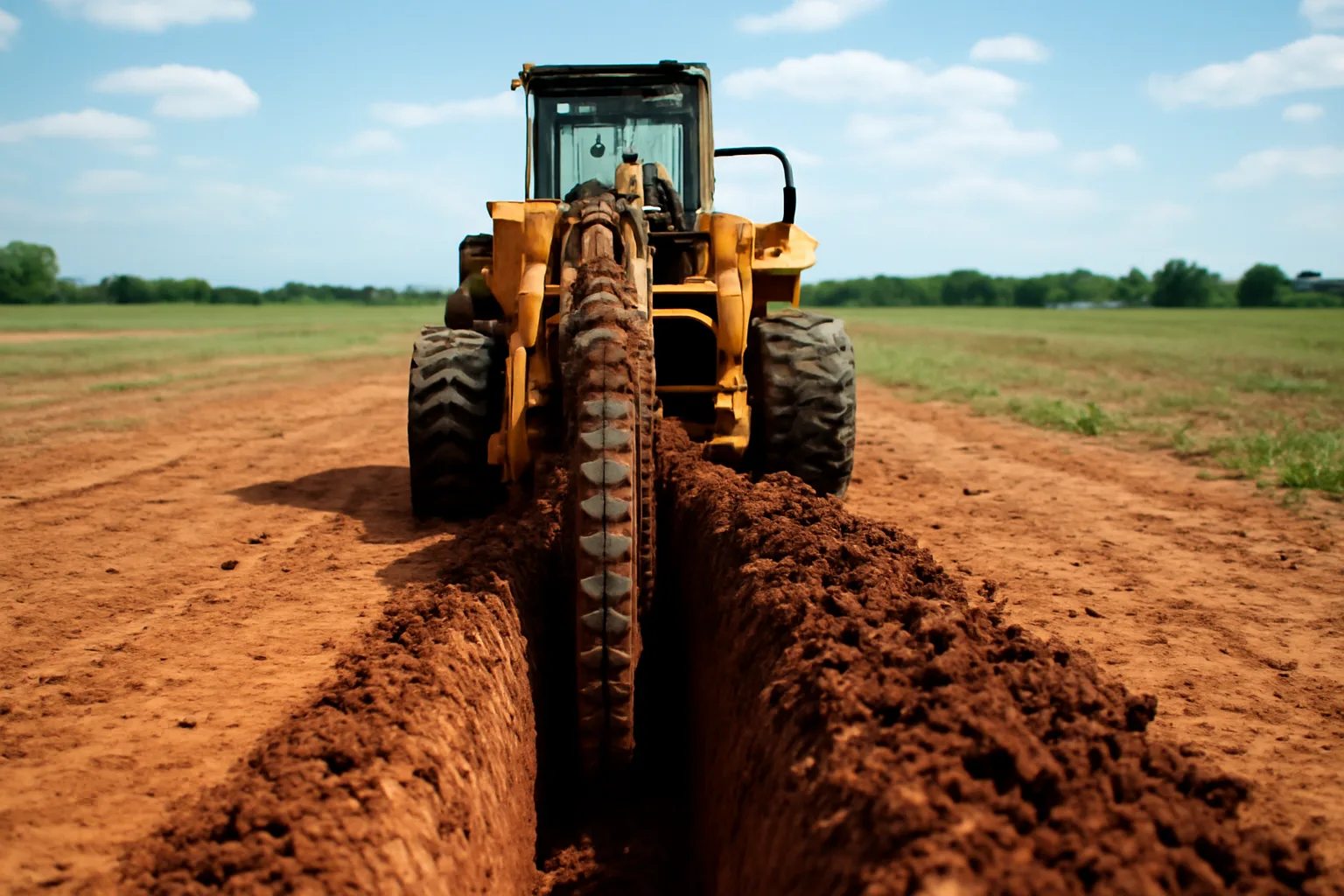
A one-machine crew can lay 1,500 to 3,000 linear feet of tile per day on good ground. That's the number that drives everything else, along with acreage, equipment capacity, and weather.
A 20-acre field with 8,000 linear feet of pipe takes a competent one-machine crew 3 to 5 working days to trench and lay, plus a day for outlet work and backfill cleanup. [10]
Weather complicates scheduling. Alabama's wet season runs roughly November through April. Saturated clay soils don't just slow machines; they produce ruts that compound the drainage problem you're trying to fix. Most experienced Alabama contractors install in summer and early fall when soils are drier and firmer.
For residential jobs, a single French drain run of 300 feet takes a crew one day with a walk-behind trencher, sometimes two if access is tight or the trench needs hand work around utilities.
Permit processing is usually the longest single delay. If ADEM or USACE review is triggered, add 30 to 90 days for a Nationwide Permit verification, or 6 to 18 months for an individual Section 404 permit. Plan your schedule around the permit path, not the installation day count.
Does Alabama have any drainage-specific regulations beyond contractor licensing?
Yes. Three bodies of law come up regularly.
Alabama drainage law (common law nuisance and trespass). Alabama follows a modified natural flow doctrine. You have a general right to drain your land, but you can't artificially concentrate water onto a neighbor's land in a way that causes damage beyond what would happen naturally. Case law under this doctrine means drainage tile outfall placement and outlet design carry liability implications, more than permit ones.
Alabama floodplain management. ADEM coordinates the National Flood Insurance Program in Alabama. Any drainage work in a mapped Special Flood Hazard Area needs a floodplain development permit from the local administrator. [11] FEMA maintains the current FIRM maps for Alabama counties.
Conservation district oversight. Alabama's Soil and Water Conservation Committee coordinates county conservation districts that provide technical assistance and, in some cases, cost-share for drainage improvement projects. They don't issue contractor licenses, but they're a practical resource for design review before you dig. [12]
For owners comparing Alabama's regulatory environment against other states, drainage tile license in Colorado and drainage tile license in California show how much varies state to state.
What insurance does an Alabama drainage tile contractor need?
Alabama Code Title 25, Chapter 5 requires workers' compensation coverage for any employer with five or more employees. Farm employers get a partial break: those with fewer than five regular non-seasonal employees may qualify for an exemption, but the law here has nuance, so confirm current status with the Alabama Department of Labor. [4]
General liability insurance isn't mandated by state law for most contractor classifications, but it's effectively mandatory in practice. Private project owners, municipalities, and NRCS cost-share programs all require proof of coverage before work starts. A $1 million per occurrence/$2 million aggregate policy is the standard market expectation for small to mid-size drainage contractors.
Commercial auto coverage for any vehicle driven on public roads for business is required under Alabama Code Title 32, Chapter 7. [13] A pickup towing a tile plow trailer is a commercial vehicle in this context.
Umbrella policies above your primary GL limit are worth considering once you're doing jobs over $100,000. A single property damage claim from a misdirected outlet flooding a neighbor's field can easily exceed a $1 million primary limit.
How do you apply for an Alabama general contractor license step by step?
The ALBGC process has five steps.
Step 1: Determine your classification. Decide whether you need Municipal and Utility, General Building, Irrigation, or another subclassification based on the work you plan to perform. The ALBGC publishes a classification description list. [2]
Step 2: Designate a qualifying party. This person, often the owner or a senior employee, must pass the relevant PSI exam. They take responsibility for the license and must stay associated with the business as long as the license is active.
Step 3: Pass the exam. Schedule through PSI. The exam covers trade knowledge, OSHA safety requirements, and Alabama business law. [5] Study materials are available through PSI and commercial exam prep providers.
Step 4: Assemble your application package. This includes the completed ALBGC application form, exam score report, financial statements or net worth documentation, surety bond or proof of financial responsibility, certificate of insurance, and the application fee.
Step 5: Submit and wait for the board meeting. The ALBGC board meets monthly. Applications received before the cutoff go on the next meeting's agenda. After approval, your license certificate arrives by mail. [2]
Renew annually. The ALBGC mails renewal notices, but the obligation to renew on time is on you. Operating without a current license on a project that requires one is a misdemeanor under Alabama Code Section 34-8-9. [1]
Are there any Alabama-specific resources that help with drainage tile planning?
Several state-level resources are genuinely useful.
Alabama NRCS State Office. NRCS Alabama administers EQIP and other cost-share programs that pay a portion of drainage tile installation on agricultural land. Its design standards for subsurface drain (practice code 606) give a baseline that experienced Alabama drainage contractors work from. [9]
Alabama Cooperative Extension System. Auburn University Extension publishes guidance on water management for Alabama crops, including subsurface drainage for cotton, corn, and soybean production in the state's clay soils. [14]
USACE Mobile District. For any project near waters of the United States, the Mobile District is your contact for Section 404 permit questions. Its Regulatory Office processes Nationwide Permit Pre-Construction Notifications (PCNs) for Alabama. [6]
Alabama Soil and Water Conservation Committee. County conservation district offices connect you with technical staff for free design consultation on small agricultural drainage projects, especially if you're pursuing cost-share funding. [12]
If you're building out a full business plan, how to start drainage tile in Alabama pulls these resources together in a step-by-step format. The grade and layout planning tools at DrainageTilePath (/start) are designed to work alongside NRCS design standards, not replace them.
Frequently asked questions
Do you need a license for drainage tile in Alabama?
Alabama requires a state contractor license from the ALBGC for any drainage tile work where the total project cost reaches $50,000 or more. Below that threshold, no state license is required, though county or municipal permits may still apply. Work on your own agricultural land for your own use is not contracting and requires no license regardless of cost. Confirm the current threshold with the ALBGC because the legislature can change it.
What is the $50,000 threshold for contractor licensing in Alabama?
Under Alabama Code Section 34-8-1, any contractor performing construction or improvement work with a total project cost at or above $50,000 must hold a state license from the ALBGC. The threshold applies to the total contract value, more than labor or materials separately. If a single drainage tile job crosses that line, you need to be licensed before signing the contract.
How much does drainage tile cost in Alabama?
Agricultural subsurface tile runs roughly $1.50 to $3.50 per linear foot installed, including materials and labor, for standard 4-inch perforated pipe in open field conditions. Residential applications typically run $3.00 to $7.00 per linear foot. A 20-acre farm drainage project can total $20,000 to $30,000 or more depending on soil conditions and outlet complexity. Alabama's heavy clay soils in the Black Belt push costs toward the higher end.
How long does drainage tile installation take in Alabama?
A one-machine crew can install 1,500 to 3,000 linear feet of tile per day on workable ground. A 20-acre agricultural drainage system takes roughly 3 to 6 working days for installation plus outlet work. Residential French drains often take one to two days. Permit processing, particularly if ADEM or Army Corps review is triggered, is typically the longest delay and can add 30 days to several months.
Which ALBGC license classification covers drainage tile contracting?
The Municipal and Utility (MU) classification covers underground drainage, storm sewer, and pipeline work and is the most common fit for dedicated drainage tile contractors. The General Building Contractor (BC) classification also covers site grading and drainage. Irrigation (IR) applies to some agricultural subsurface drainage scopes. Check the ALBGC classification descriptions and pick the one that matches your primary work type, then confirm with the board if you're unsure.
Does Alabama require any permits beyond a contractor license for drainage tile work?
Yes. Work affecting wetlands or waterways may require a Section 404 permit from the U.S. Army Corps of Engineers (Mobile District) and a state 401 certification from ADEM. Land disturbance over one acre commonly triggers a county erosion and sediment control permit. Work in FEMA-mapped floodplains requires a floodplain development permit. The contractor license is a credential; these permits are site-specific approvals.
Can a property owner install drainage tile on their own land in Alabama without a license?
Yes. Alabama's contractor licensing law applies to contractors performing work for others for compensation. A landowner doing drainage tile work on their own property, for their own benefit, is not acting as a contractor and does not need a state license. Federal and local permit requirements (Army Corps Section 404, county land disturbance permits) still apply based on site conditions regardless of who is doing the work.
What insurance does an Alabama drainage tile contractor need?
Workers' compensation is required under Alabama Code Title 25, Chapter 5 for employers with five or more employees, with partial exemptions for qualifying farm employers. General liability insurance is not state-mandated but is practically required by project owners and cost-share programs, with $1 million per occurrence being the standard market expectation. Commercial auto coverage is required for business-use vehicles under Alabama Code Title 32, Chapter 7.
Does NRCS offer cost-share for drainage tile in Alabama?
Yes. USDA NRCS administers the Environmental Quality Incentives Program (EQIP) in Alabama, which includes payment for Subsurface Drain installation under practice code 606. Payment rates are set annually by county and reflect actual installed costs. To qualify, you work with your local NRCS field office to develop a conservation plan and apply during the open sign-up period. Wetland and highly erodible land restrictions apply.
How long does it take to get an Alabama contractor license for drainage work?
Plan on 6 to 12 weeks from starting your application to receiving your license. The ALBGC board meets monthly, so application timing relative to the meeting cutoff matters. Add 2 to 6 weeks of exam preparation and 1 to 2 weeks to schedule a PSI exam slot. Incomplete applications restart the clock. Nobody publishes a precise average approval time for Alabama specifically, so treat 8 weeks as a realistic midpoint estimate.
What does the ALBGC exam cover for drainage or utility contractor classifications?
The PSI exam for Alabama contractor classifications covers trade-specific technical knowledge (excavation, drainage, utilities), OSHA safety regulations, and Alabama business and construction law. The exam is closed-book and administered at PSI testing centers. PSI publishes a candidate information bulletin for each classification that lists exact content areas and references. Study materials are available through PSI and third-party exam prep providers.
Are there county-level drainage tile rules in Alabama that differ from state rules?
Yes. Below the $50,000 state licensing threshold, Alabama counties control their own contractor licensing requirements, and many larger counties (Jefferson, Madison, Mobile) do require local licenses or permits for contracting work. Separately, every county has a floodplain administrator who enforces local floodplain ordinances that affect drainage construction. Check with the specific county building or engineering department for the project location before starting work.
What is Alabama's drainage law for water flowing onto a neighbor's property?
Alabama courts apply a modified natural flow doctrine. Landowners have a right to reasonably drain their property, but artificially concentrating and directing water onto a neighbor's land in a way that causes material harm beyond natural drainage can constitute trespass or nuisance. Drainage tile outfall design and outlet placement carry real liability exposure under this doctrine. This is a civil law matter, not a licensing issue, but it directly affects how drainage tile systems should be engineered and where outlets are placed.
Sources
- Alabama Legislature, Code of Alabama Section 34-8-1: Alabama requires a state contractor license for construction work with a total cost of $50,000 or more, and operating without a required license is a misdemeanor under Section 34-8-9
- Alabama Department of Labor, Workers' Compensation Division: Alabama Code Title 25, Chapter 5 requires workers' compensation coverage for employers with five or more employees, with partial exemptions for qualifying farm employers
- PSI Exams: Alabama uses PSI Exams for contractor trade licensing exams; exam covers trade knowledge, OSHA safety, and Alabama construction law; exam fee applies
- U.S. Army Corps of Engineers Mobile District, Regulatory Program (Section 404 Permits): USACE Mobile District processes Section 404 Clean Water Act permits for Alabama; Nationwide Permits apply to minor impacts; individual permits required for larger impacts to wetlands and waters
- U.S. EPA, National Pollutant Discharge Elimination System (NPDES) Stormwater Program: Land disturbance of one acre or more triggers construction stormwater permit coverage requirements; Alabama counties commonly adopt this threshold for local erosion and sediment control permit requirements
- USDA Agricultural Research Service, Drainage Installation Equipment Productivity, Agricultural Water Management Vol. 97: A trencher-based drainage tile installation crew can install 1,500 to 3,000 linear feet per day on typical agricultural soils under favorable conditions
- Alabama Department of Environmental Management: ADEM coordinates the National Flood Insurance Program in Alabama; drainage work in FEMA-mapped Special Flood Hazard Areas requires a floodplain development permit
- Alabama Legislature, Code of Alabama Title 32 Chapter 7, Motor Vehicle Safety-Responsibility Act: Alabama Code Title 32, Chapter 7 requires commercial auto insurance for vehicles operated on public roads for business purposes, including contractor vehicles and equipment trailers
- Auburn University Alabama Cooperative Extension System: Auburn University Extension publishes guidance on subsurface drainage considerations for Alabama crops in clay soils, including recommended tile spacing and depth for cotton, corn, and soybeans