Last updated 2026-08-17
TL;DR
Drainage tile in Alaska costs $3 to $12 per linear foot installed on road-accessible ground, and $8 to $20 or more per foot on remote parcels. No statewide license covers drainage tile specifically, but wetlands review under Section 404 applies to much of Alaska's land. Field work runs 1 to 5 days. Total projects run 2 to 5 months once permitting is counted.
How much does drainage tile cost in alaska?
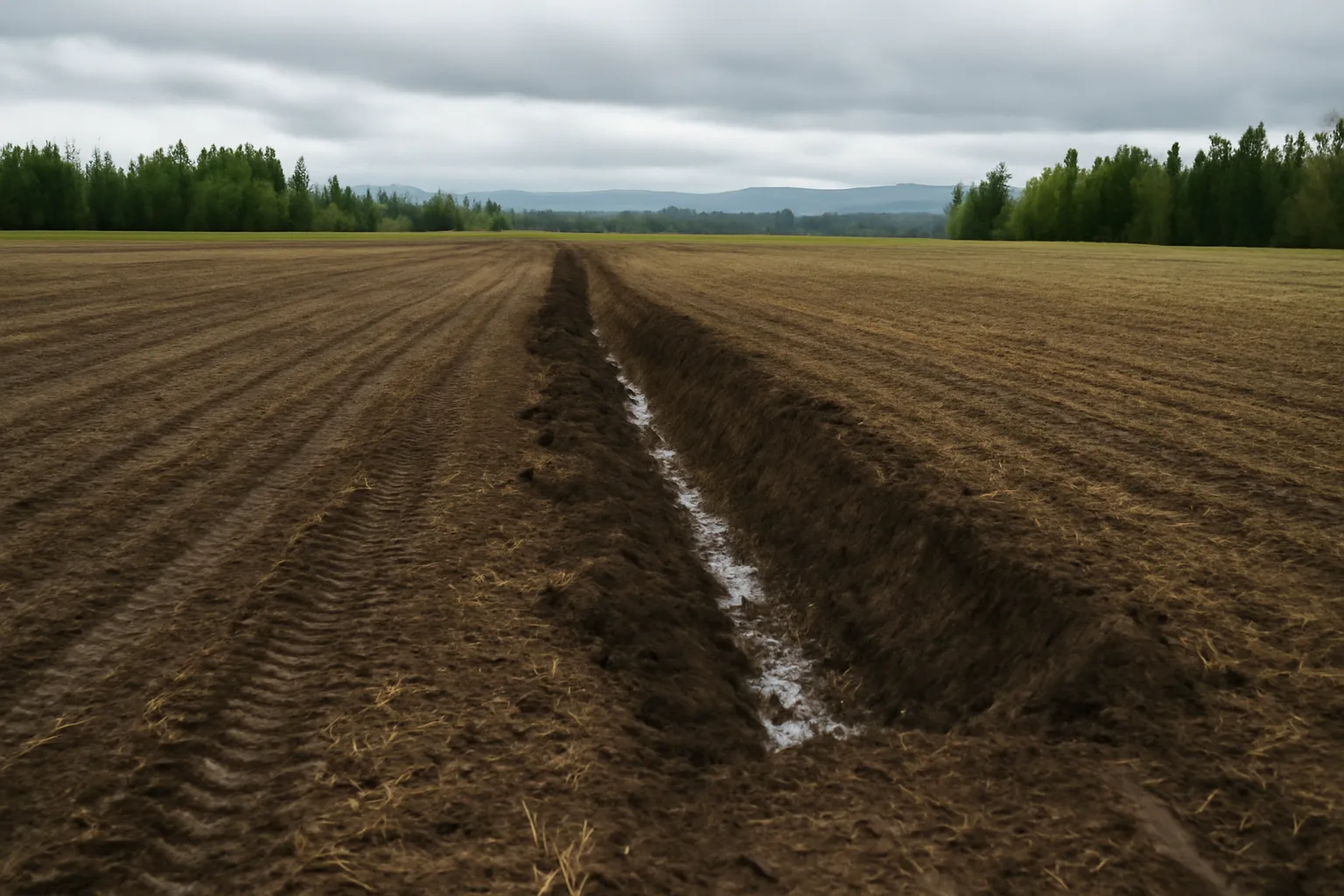
The honest range for drainage tile in Alaska is $3 to $12 per linear foot installed. That spread is real, not padding. On the low end, a landowner on accessible, non-permafrost ground near the road system pulls in a local excavator with a trencher. On the high end, a remote parcel off the road system means the excavator arrives by barge, fuel costs triple, and freeze-thaw cycles push the contractor to pad the quote with contingency before they even walk your land.
Materials alone tell part of the story. Four-inch corrugated perforated polyethylene tubing, the most common product in Alaska small-farm and rural drainage work, runs roughly $0.40 to $0.80 per foot for the pipe [1]. Sock filter fabric, outlet fittings, and gravel envelope add another $0.50 to $1.50 per foot depending on how much cover material you truck in. Labor and equipment are where Alaska splits from the Lower 48. Excavation labor in Anchorage averages $95 to $130 per hour, and in rural hubs like Fairbanks or Kodiak it runs higher, because equipment mobilization is a line item on its own.
For a 1,000-foot tile run on accessible ground near Anchorage, budget $4,000 to $8,000 all-in. That same run on a remote homestead reachable only by floatplane or barge could clear $15,000 to $20,000 without blinking. Nobody has clean statewide data on Alaska drainage tile costs specifically. The ranges here come from Alaska DOT construction cost data, University of Alaska Fairbanks Cooperative Extension agricultural guides, and contractor pricing patterns in the Matanuska-Susitna Valley [2].
The national installed cost for agricultural drainage tile is roughly $1.50 to $4 per linear foot in the Midwest, where flat terrain and dense contractor networks push prices down [3]. Alaska is genuinely different. Accept that early and your budgeting gets easier.
What factors drive drainage tile costs higher in alaska?
Several things stack up in Alaska that don't exist in most states. Knowing them helps you scope a project honestly before you call a contractor.
Permafrost is the big one. Trench into a permafrost zone and disturb the insulating organic mat, and you can trigger thermokarst subsidence that makes your tile run heave and shift within a season or two. The University of Alaska Fairbanks Cooperative Extension publishes installation depth and timing guidance to reduce that risk [2]. Getting permafrost engineering right adds cost. Getting it wrong adds more.
Short construction seasons compress everything. The practical window for trench work on most Alaska properties is late May through September, shorter at high latitude or high elevation. Contractors who can work that window book fast, and peak-season rates reflect it.
Freight and mobilization are line items, not footnotes. If your parcel isn't on the road system, a trencher gets barged or flown in. A small trencher weighs 4,000 to 8,000 pounds, and coastal barge freight adds a real number to the total before a shovel moves [4]. That mobilization alone can add $1,000 to $3,000.
Wetlands permitting, covered in its own section below, adds soft costs too: agency review time, a consultant to prepare the application, and the chance that required mitigation changes your design.
| Cost Factor | Lower 48 Typical | Alaska Typical |
|---|---|---|
| Corrugated PE pipe (4-inch), materials | $0.30, $0.60/ft | $0.40, $0.80/ft |
| Labor + trenching (road-accessible) | $1.00, $3.00/ft | $3.00, $8.00/ft |
| Labor + trenching (remote, off road system) | N/A | $8.00, $20.00/ft |
| Mobilization (remote barge/floatplane) | $0 | $1,000, $5,000+ |
| Permafrost engineering consult | N/A | $500, $3,000 |
| Wetlands permit (if required) | $0, $500 | $0, $2,000+ |
Do you need a license for drainage tile work in alaska?
Alaska has no license aimed specifically at drainage tile installation, the way some states run licensed drainage contractor programs. That doesn't mean you skip licensing questions entirely.
General contracting in Alaska is regulated at the state level. Any contractor you hire to install drainage tile for pay must hold an Alaska Business License, and if the work exceeds $10,000 in value, a contractor's registration with the Alaska Department of Commerce, Community, and Economic Development (DCCED) under AS 08.18 [5]. If you're working your own land, you're generally exempt from contractor registration, but confirm that with DCCED before you start.
There's no separate "drainage tile contractor" category in Alaska's occupational licensing structure as of 2026. The work falls under general excavation or earthworks. If any electrical components are involved (sump pumps, electronic controls), a separate electrical permit and a licensed electrician are required.
For agricultural drainage funded through USDA programs, NRCS Alaska may require documentation that installed practices meet their technical standards under Practice Standard 606 for subsurface drains. That's a compliance requirement, not a state license [6].
Verify current contractor registration thresholds directly with the Alaska DCCED. Categories and dollar thresholds do change.
What permits does drainage tile require in alaska?
This is where Alaska gets genuinely more complex than most Lower 48 states, and where first-timers get surprised.
Wetlands are the main issue. Alaska contains roughly 175 million acres of wetlands, about 63% of all wetlands in the United States [7]. A huge share of agricultural and rural land in Alaska is jurisdictional wetland under Section 404 of the Clean Water Act. Installing drainage tile that drains or fills a jurisdictional wetland without a permit from the U.S. Army Corps of Engineers (USACE) Alaska District is a federal violation.
The Army Corps Alaska District administers Section 404 permits. Nationwide Permit 40 covers certain agricultural activities including drainage tile, but it comes with preconditions and reporting requirements, and it doesn't cover every situation [8]. If your project doesn't qualify for a nationwide permit, you're into an individual permit, which is a months-long process.
Alaska also runs its own habitat program. Projects that affect state fish-bearing waters may require a Title 16 Fish Habitat Permit from the Alaska Department of Fish and Game (ADF&G) [9].
Municipal and borough permits vary. The Municipality of Anchorage, Matanuska-Susitna Borough, Fairbanks North Star Borough, and others each set local drainage, grading, and land-disturbance rules. Check with your local planning department before you dig.
The practical move: assess the wetlands status of your parcel first. The National Wetlands Inventory mapper is a reasonable starting point, but a formal wetland delineation by a qualified professional is often worth the cost before you design your tile system.
How long does drainage tile installation take in alaska?
For a road-accessible project on non-permafrost ground, a contractor with a trencher installs 500 to 1,500 feet of tile per day. A 2,000-foot system on a Mat-Su Valley farm physically goes in over 2 to 3 field days. Add a day each side for site prep and cleanup and you're at about a week of field time.
That's the fast case. Alaska adds time at every step.
Design and permitting can run 4 to 16 weeks before the first shovel moves, depending on whether you need USACE Section 404 review, ADF&G coordination, or a borough grading permit. NRCS technical assistance for cost-share programs like EQIP has its own queue, and Alaska NRCS offices cover a massive geographic area with limited staff.
Scheduling a contractor can add 4 to 12 weeks in peak season, June through August. The Alaska excavation market is small relative to the state's geography.
If your site is off the road system, add the time to arrange barge or charter freight. Summer barge schedules to many coastal communities run weekly or biweekly.
Frozen ground is a hard stop. Even in early June, some Interior Alaska soils stay frozen at depth. Trenching frozen ground wrecks equipment and gives poor results. Most experienced contractors won't touch it.
Realistic total for a permitted, road-accessible project: 2 to 5 months from decision to completion, with field installation the shortest phase. For remote or complex sites, budget a full season or plan to span two.
Does USDA NRCS offer cost-share for drainage tile in alaska?
Yes, and it's worth checking before you self-fund the whole project.
USDA's Environmental Quality Incentives Program (EQIP) pays cost-share for conservation practices including subsurface drainage (Practice Code 606). Alaska NRCS has funded drainage improvements on agricultural land in the Mat-Su Valley and other farming areas under EQIP [6]. Payment rates vary by practice, area, and fiscal year, and funding is competitive. You apply during a signup period and NRCS ranks applications.
To get EQIP cost-share for drainage tile, you'd typically need a conservation plan from NRCS, a practice design that meets NRCS Alaska technical standards, and installation according to that design with NRCS sign-off. The cost-share rate is often 50 to 75% of an established payment schedule, not 50 to 75% of whatever a contractor quotes you. That distinction matters.
Contact the Alaska NRCS State Office in Palmer for current payment schedules and signup periods. They can also tell you whether your parcel and intended practice qualify. Wetland Conservation provisions under USDA's Highly Erodible Land rules ("Swampbuster") may limit what drainage work keeps its federal program benefits [10].
How does drainage tile cost in alaska compare to nearby states?
Alaska is the outlier at the high end. It helps to see that framed concretely.
Idaho, with significant agricultural drainage work in its Magic Valley and Palouse areas, runs $1.50 to $5 per linear foot installed. California's Central Valley, where labor is expensive but terrain is flat and contractor supply is good, runs $2 to $6 per foot (see drainage tile cost in california). Colorado's eastern plains, with a farming profile similar to parts of Alaska's Tanana or Mat-Su valleys, run $1.50 to $4 per foot (see drainage tile cost in colorado).
Alaska's road-accessible cost of $3 to $12 per foot already sits above all of these. The remote-site premium of $8 to $20 or more per foot puts Alaska in its own category.
The cause isn't contractor greed. It's input cost: fuel, freight, equipment wear from permafrost conditions, shorter working seasons, and a smaller contractor base. Compare an Alaska quote to a Midwest benchmark you found online and you're comparing apples to caribou.
For reference, drainage tile cost in idaho and drainage tile cost in arizona show what these same inputs look like in states with more mature drainage markets and more temperate conditions.
What type of drainage tile works best in alaska conditions?
Corrugated polyethylene (PE) pipe is the standard choice for Alaska agricultural and rural drainage, for straightforward reasons. It flexes enough to tolerate some frost heave without cracking, it's stocked in Alaska through farm and building supply retailers, and it's light enough that freight stays manageable compared to rigid PVC or clay tile.
For most jobs, 4-inch corrugated perforated PE with a non-woven geotextile sock is the workhorse. Sock filters matter in Alaska's fine-grained glacial soils and silt deposits, where sediment migration into the pipe would clog the system fast.
In ground with heavy organic soil or peat, some designers spec larger-diameter pipe (6-inch) to keep flow even if partial organic clogging builds over time. Organic soils are common across Alaska's lowland agricultural areas.
For outlets in freeze-thaw ground, concrete or HDPE structures set below frost depth beat ABS fittings, which go brittle at sustained cold. Outlet protection from ice scour at ditch edges is a real detail that's easy to skip and painful to fix.
If you're doing your own layout and grading design, the $179 one-time kit from DrainageTilePath covers GPS-based grade planning, outlet selection guidance, and installation layout. It's a reasonable place to start before you bring in a contractor for a quote at /start.
What are the real ongoing costs after drainage tile is installed in alaska?
Once your tile is in and working, annual costs drop well below the install, but they're not zero.
Outlet inspection is the main recurring task. Alaska outlets are vulnerable to ice damage in spring, when sheet ice moving in roadside ditches or natural channels shears off outlet pipes at grade. A seasonal check in late April or May takes an hour and can save you from a plugged system all season. If an outlet needs re-setting or armoring with rock, budget $200 to $600 for a local contractor.
Sediment flushing may be needed every 3 to 7 years depending on soil type and install quality. Jetting a tile line runs roughly $0.50 to $1.50 per foot, so a 2,000-foot system costs $1,000 to $3,000 to flush. Nobody has great Alaska-specific data on flushing intervals. The range comes from Midwest extension guidance, and Alaska's siltier soils may warrant more frequent checks.
Permafrost-related shifting is the wildcard. A system in marginal permafrost may need spot repairs where the ground has moved. Budget a contingency of $500 to $2,000 per decade for transitional permafrost zones, more if active-layer deepening is accelerating in your area.
For how Alaska's ongoing costs stack against another remote, high-cost state, see drainage tile cost in hawaii.
How do you find a qualified drainage tile contractor in alaska?
The Alaska contractor market for agricultural drainage tile is thin outside the Mat-Su Valley and Fairbanks areas. That's the reality.
Start with the Alaska NRCS office in Palmer. They work with contractors regularly on EQIP practice installations and can often hand you referrals or a list of contractors who have installed NRCS-approved drainage systems in Alaska [6]. For anyone doing agricultural drainage in the state, this is the single best referral source.
The Alaska Division of Agriculture keeps contacts with the Mat-Su farming community and can point you toward contractors active in that market [11].
The Associated General Contractors of Alaska has a member directory that includes excavation firms, though drainage tile isn't a listed specialty. You'll ask individual firms about their drainage tile experience.
When you call a contractor, ask specifics. Have they worked drainage tile in your soil type? Have they handled permafrost considerations? Do they know the wetlands permit situation for your area? A contractor who knows the work asks about your outlet elevation and grade before quoting. One who doesn't ask is probably winging it.
Get at least two quotes. Given the wide range of Alaska pricing, a second quote on a larger project could save you $5,000 to $15,000, or confirm the first quote was fair.
For how contractor markets look in other western states, drainage tile cost in arizona and drainage tile cost in colorado are useful reads.
Frequently asked questions
How much does drainage tile cost per foot in alaska?
Installed cost for drainage tile in Alaska runs $3 to $12 per linear foot for road-accessible sites and $8 to $20 or more per foot for remote parcels off the road system. Materials alone (4-inch corrugated PE pipe plus sock and fittings) are roughly $1 to $2.50 per foot. The gap from national averages reflects Alaska-specific costs: fuel, freight, shorter seasons, and permafrost engineering.
Do you need a license to install drainage tile in alaska?
Alaska has no specific drainage tile contractor license. Any contractor doing paid work over $10,000 must hold an Alaska Business License and contractor registration under AS 08.18 through the state DCCED. Landowners doing their own work are generally exempt from contractor registration. Wetlands and fish habitat permits may be required separately, independent of contractor licensing. Confirm current requirements with DCCED directly.
How long does a drainage tile project take in alaska?
Field installation on a road-accessible site takes 2 to 5 days for a typical 2,000-foot system. Total project time from decision to completion is usually 2 to 5 months once you include permitting (4 to 16 weeks if wetlands review is needed), contractor scheduling in peak season, and any NRCS coordination. Remote sites or complex permits can push the timeline to a full year or across two construction seasons.
Does Alaska require a wetlands permit for drainage tile?
Often yes. Alaska contains about 63% of all U.S. wetlands, so many rural and agricultural parcels are jurisdictional under Section 404 of the Clean Water Act. Drainage tile that drains or fills a jurisdictional wetland requires authorization from the U.S. Army Corps of Engineers Alaska District. Work near fish-bearing waters may also need an ADF&G Title 16 Fish Habitat Permit. Assess your parcel's wetlands status before you design a tile system.
Can USDA NRCS help pay for drainage tile in alaska?
Yes. USDA EQIP provides cost-share for subsurface drainage (Practice Code 606) on eligible agricultural land in Alaska. Cost-share rates are typically 50 to 75% of NRCS payment schedules, not necessarily your contractor's quote. Applications are competitive and filed during signup periods. Contact the Alaska NRCS State Office in Palmer for current payment rates and signup windows.
What type of drainage tile pipe is best for alaska?
Corrugated perforated polyethylene (PE) pipe with a non-woven geotextile sock filter is the standard choice for Alaska. It tolerates frost heave better than rigid PVC, it's available in-state, and it's light enough to freight to remote sites. In silty glacial soils, the sock filter is essential to prevent sediment clogging. Outlets should use HDPE or concrete set below frost depth, as ABS fittings become brittle in sustained cold.
How does drainage tile cost in alaska compare to other states?
Alaska's road-accessible cost of $3 to $12 per foot is already above most Lower 48 states. Idaho and Colorado run $1.50 to $5 per foot, California around $2 to $6. Alaska's remote-site cost of $8 to $20 or more per foot has no real Lower 48 equivalent. The difference is structural: freight, mobilization, short seasons, permafrost considerations, and a thinner contractor market, not simply higher labor rates.
When is the best time of year to install drainage tile in alaska?
Late May through September is the practical installation window for most Alaska sites. June through August is peak contractor season. Frozen ground prevents effective trenching in most areas before mid-May, and early freeze-up typically ends projects by October. In the Interior, the window can be shorter. Scheduling a contractor in early spring (March or April) for a summer install is strongly advisable given limited contractor availability.
Can I install drainage tile myself in alaska to save money?
On your own land, you're generally exempt from Alaska's contractor registration requirements. DIY installation is feasible for small systems on accessible, non-permafrost ground with good outlet points. You'll still need to assess and address any wetlands permitting requirements, which apply regardless of who does the work. Grade accuracy is critical; a GPS grade tool or laser level is worth the investment before you trench.
What ongoing maintenance costs should I budget for drainage tile in alaska?
Annual outlet inspection is minimal (an hour of your time). Sediment flushing runs $0.50 to $1.50 per foot every 3 to 7 years depending on soil. Spring ice damage to outlets is a real Alaska-specific risk; budget $200 to $600 for periodic outlet repairs. Systems in transitional permafrost zones may need spot repairs from frost heave every several years. Total annual ongoing cost for a 2,000-foot system is typically $200 to $800 in a normal year.
Are there drainage tile cost differences between Anchorage, Fairbanks, and rural alaska?
Yes, meaningfully. Anchorage and the Mat-Su Valley have the most accessible contractor market and lowest mobilization costs. Fairbanks is similar for road-accessible sites, though with more permafrost variability. Rural and off-road-system sites anywhere in Alaska face barge or air freight costs that add $1,000 to $5,000 or more just to mobilize equipment, pushing per-foot costs well above road-accessible benchmarks.
What is swampbuster and does it affect drainage tile in alaska?
Swampbuster is the informal name for USDA's Wetland Conservation provisions under the Food Security Act. It says that if you drain a wetland to produce a crop on it for the first time, and you receive USDA program benefits, you can lose those benefits. This can affect drainage tile projects on Alaska agricultural land with wetland components. Alaska NRCS can determine whether your proposed drainage triggers Swampbuster restrictions before you install.
Sources
- University of Alaska Fairbanks Cooperative Extension, Agricultural publications catalog: Corrugated perforated PE pipe and geotextile sock filter materials are standard for Alaska agricultural drainage; material cost ranges referenced against Alaska retail supply
- University of Alaska Fairbanks Cooperative Extension: UAF Cooperative Extension recommends specific installation timing and depth considerations for drainage tile in permafrost-affected soils
- Alaska Department of Transportation and Public Facilities: Alaska DOT construction cost data reflect elevated mobilization and freight costs for remote Alaska construction projects
- Alaska Department of Commerce, Community, and Economic Development, Contractor Registration: Contractors doing paid work over $10,000 in Alaska must hold a Business License and contractor registration under AS 08.18
- U.S. Fish and Wildlife Service, National Wetlands Inventory: Alaska contains approximately 175 million acres of wetlands, about 63% of all U.S. wetlands
- U.S. Army Corps of Engineers, Nationwide Permits: Nationwide Permit 40 covers certain agricultural drainage activities under Section 404 of the Clean Water Act with conditions
- Alaska Department of Fish and Game, Habitat Division: Alaska ADF&G Title 16 Fish Habitat Permits are required for work in or near fish-bearing waters in Alaska
- Alaska Division of Agriculture: Alaska Division of Agriculture supports agricultural development including Mat-Su Valley farming operations and can provide contractor referrals