Last updated 2026-08-21
TL;DR
Drainage tile renewal in Hawaii is uncommon, and the paper is the hard part. Paid work usually needs a Hawaii contractor license (often C-43 or A), county grading review, 811 locates, and a Clean Water Act 404 check if you touch wetlands. No statewide installed-cost series exists. Bid locally. Confirm fees with DCCA and the county. Do not assume a farm job is exempt.
What is drainage tile renewal in Hawaii?
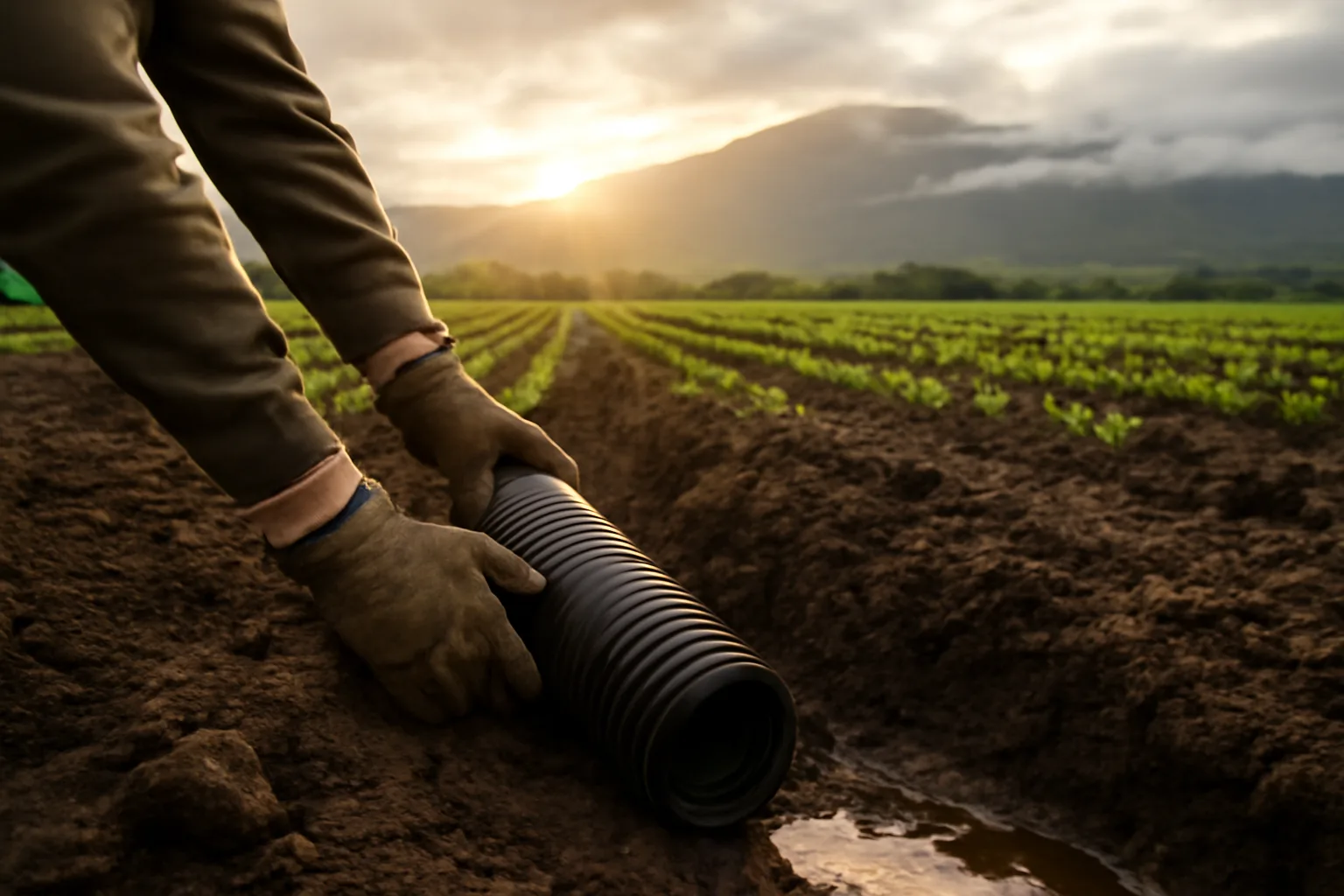
Drainage tile renewal in Hawaii means repairing, replacing, or re-outletting subsurface drain lines so a field can shed perched water again. It is construction and water-law work, not a state program with that name. Most islands never had Midwest-style pattern tile, so renewal often means a short collector, a crushed outlet, or a plantation-era ditch someone later piped.
People say tile for corrugated polyethylene pipe, old clay segments, and even open drains. On the ground it is pipe, grade, and an outlet that does not dump sediment into a stream, wetland, or lo'i. Drainage tile Hawaii jobs are usually small and irregular. Former sugar and pineapple land still has collector ditches, culverts, and a few buried lines. New pattern grids are rare.
I treat renewal as the same alignment, same purpose, and same outlet type. Anything that deepens, lengthens, or dries a wet flat is new work. That line matters later under Clean Water Act section 404 [7][8]. A beautiful trench that cannot legally discharge is a ditch full of money.
If you learned this trade in Illinois, reset. Parcel size, lava, freight, and waterbird habitat change the job. For another non-Midwest paper path, read drainage tile renewal in Alaska. Walk the outlet to the gulch before you call a trencher.
Do you need a license for drainage tile in Hawaii?
Yes, most paid drainage tile work in Hawaii needs a contractor license. HRS 444-9 is blunt. The statute says, "No person within the purview of this chapter shall act, or assume to act, or advertise, as general engineering contractor, general building contractor, or specialty contractor without a license previously obtained under and in compliance with this chapter and the rules of the contractors license board." [1]
That covers acting and advertising. A Facebook post offering tile installation is already in the statute's crosshairs if you lack a license. HRS 444-9 is the rule I plan around, not the rumor that farm work is always free of licensing.
Some owner and employee fact patterns sit in HRS 444-2 exemptions [3]. Read the current text. A farm using its own employees on land it controls is a different case than you taking money to tile a neighbor's field. The small-job exemption is a low dollar cap written into the statute. Confirm the current figure in HRS 444-2. I would not build a side business on that cap.
Owner-builder rules are narrower than people hope. They do not turn you into a public tile contractor. If you want to bid drainage tile Hawaii work, get licensed or subcontract to someone who is. Confirm application steps, experience affidavits, exams, insurance, and any fee with the DCCA Professional and Vocational Licensing Contractor License Board. Do not copy a fee from an old blog [15].
Unlicensed contracting can bring civil and criminal penalties under chapter 444. I would not test that. If you only need one field fixed, hire a licensed firm and stay out of the board's mail.
Which Hawaii contractor classification covers drainage tile?
There is no license titled drainage tile. HRS 444-7 defines a general engineering contractor (class A) around fixed works that include drainage, irrigation, water supply, and flood control [2]. That is the clean statutory hook for larger earthwork plus pipe.
Most specialty shops look at C-43 (sewer, sewage disposal, drain, and pipe laying) because the classification name includes drain and pipe laying. C-17 (excavating, grading, and trenching) can cover the hole and not the pipe system. Do not pick a class from a forum screenshot. Ask the Contractor License Board whether your actual scope fits A, C-43, or a listed combination before you print cards [15].
I would not chase an A license if you only lay ag drain pipe and small outlets. I also would not bid a full collector system, pump station, and stream outfall on a thin C-17 card. The board classifies the work you offer, not the crop that grows after.
| Path | What the paper actually is | When I would use it |
|---|---|---|
| Farm crew on employer land | May fall outside contracting if you are not offering services to others. Confirm HRS 444-2 [3]. | Owner's employees only |
| C-43 specialty | Drain and pipe laying classification. Confirm the current description with the board [15]. | Tile, laterals, and outlets as a specialty firm |
| A general engineering | Statute lists drainage among fixed works [2]. | Larger earthwork plus drainage |
| Paid work with no license | Violates HRS 444-9 [1]. | Never |
Experience, exams, and bonds follow the board's current application instructions. Those details move. Confirm them. A classification fight after a complaint is a miserable way to learn the chart.
How much does drainage tile cost in Hawaii?
Nobody publishes a solid Hawaii-wide installed cost per acre for drainage tile. The closest public cost series are mainland farm custom-rate surveys, and they describe Iowa machines in Iowa dirt, not a trencher on a'a [12]. Use those numbers as a distant floor. They are not a Hawaii bid.
What you actually pay is landed pipe, fittings, a gravel envelope if the soils need it, excavation time, rock, dewatering, mobilization between islands, GET, and permit fees. Dual-wall PE pipe crosses the Pacific in a container. Freight can dwarf the Midwest mill price. I would get a landed quote at Honolulu, Kahului, Hilo, or Nawiliwili before I talk about dollars per foot.
Rock is the other silent budget. Midwest custom rates assume you can pull a plow. Much of Hawaii is lava, coral shelf, saprolite, or mixed fill over buried plantation concrete. Price hourly equipment with a rock clause. A per-acre package copied from an 80-acre Iowa grid is a waste of money on an 8-acre windward parcel.
Hawaii's statewide general excise tax rate is 4 percent [10]. Counties may add a surcharge. Confirm the current surcharge with the Department of Taxation. Build GET into the contract. Do not discover it on the invoice.
| Cost piece | What public sources show | What to do in Hawaii |
|---|---|---|
| Machine tiling custom rates | Iowa State publishes Iowa custom rates only [12]. | Treat as a mainland floor |
| Pipe and fittings | Vendor list prices, freight extra | Get a landed island quote |
| Rock and coral excavation | Not in Midwest surveys | Hourly gear plus a rock clause |
| Tax | GET is 4% statewide [10] | Add the county surcharge if it applies |
| Permits and bonds | County and Corps fees change | Confirm. Do not copy a blog |
A salesman who quotes one number per acre with no freight, no rock, and no tax is selling marketing, not an estimate.
How long does drainage tile take in Hawaii?
Field time on a small Hawaii parcel can be a few days if the run is short and the ground is soil. The paper often takes longer than the trencher. I would never promise a DCCA, county, or Corps clock. Confirm every timeline with the office that owns it.
811 locates have a statutory notice window under HRS chapter 269E. Read the current notice rules before you scratch dirt. County grading or grubbing review follows that county's code, not your harvest date. If the site is in a Special Management Area, add SMA review [9]. If the outlet alters a stream channel, the Commission on Water Resource Management's stream channel alteration process applies [8].
Wet weather on the windward side stops trenches. High water tables on coastal plains force pumps. Lava and coral turn a one-day lateral into a cutting job. Bid equipment days and weather contingency. Anyone selling a fixed three-day island tile package without walking the outlet is guessing.
License issuance and renewal times are board-controlled. HRS 444-15 governs license term and renewal mechanics, not your calendar wish [4]. Confirm current processing with DCCA. No article gets to guarantee approval.
For a wet-state contrast on pacing and water paper, see drainage tile renewal in Florida.
What permits do you need besides a contractor license?
A contractor card is not a digging permit. Plan on 811 locates, a county look at grading or grubbing if you exceed that county's thresholds, and a water-quality look if you disturb enough ground to trip Hawaii's NPDES construction rules [13]. Building permits rarely fit buried ag pipe, but do not assume zero paper because the crop is corn, seed, or forage.
Each county runs its own grading, grubbing, and stockpiling rules. Honolulu, Maui, Hawaii, and Kauai do not share one form. Call the county permitting or public works shop that covers the tax map key. Thresholds, plans, and fees change. Confirm them.
If your disturbance is large enough, Hawaii Department of Health Clean Water Branch NPDES coverage under HAR chapter 11-55 is in play [13]. The familiar federal construction trigger is one acre of disturbance, and Hawaii implements that through its own rules. Confirm the current NGPC or individual permit path with Clean Water Branch. Do not rely on an old acre figure from memory if your site is close to the line.
Coastal fields can sit in the Special Management Area under HRS chapter 205A. SMA review looks at coastal resources, not your yield map [9]. Outlets that reshape a stream may need a stream channel alteration approval from CWRM [8]. I start with the outlet and work uphill through county, DOH, Corps, and CWRM. Skipping the outlet conversation is how cheap jobs become enforcement files.
Dry-state permit stacks look different. Drainage tile renewal in Arizona is not a template for Hanalei or Kahuku.
Does Clean Water Act 404 apply to tile outlets and wetlands?
It can, and this is where drainage tile renewal in Hawaii gets serious. Section 404 regulates discharges of dredged or fill material into waters of the United States, including many wetlands [6]. A new subsurface system that converts a wet flat into dry cropland is not a paperwork-free farm chore.
Maintenance of existing drainage ditches can fall under the 404(f) farming exemptions [7]. The recapture rule pulls you back under permitting if the discharge brings a water into a new use or impairs its reach. Replacing pipe in the same trench, same depth, same purpose is the fact pattern I would take to the Corps. Deepening a ditch to dry a wetland is not that fact pattern.
Hawaii adds species and cultural weight that Midwest tile country often skips. Coastal flats and interior wetlands can hold listed waterbirds. Taro complexes are agricultural and cultural systems that are supposed to stay wet. I would call USACE Honolulu District Regulatory before I order pipe if there is any standing water, hydric soil, or stream connection [6].
Nationwide permits exist for some agricultural and outfall activities. Whether one fits is a Corps call on your drawings, not a blog call. If staff ask for a delineation, budget it. Guessing wetland lines from a truck window is how you buy two projects.
I would rather spend a month on a no-permit letter or an NWP than rebuild an illegal outlet. Enforcement is slower than a trencher and much more expensive.
What soils and rainfall actually drive tile decisions in Hawaii?
Tile is a response to a perched water problem, not a default upgrade. Hawaii soils range from young lava to deep andisols to poorly drained coastal fills. CTAHR's Soils of Hawaii walks through that range in plain language [11]. Official map units live in NRCS Web Soil Survey and the published island soil surveys. I would pull the map unit before I talk pipe spacing.
Windward slopes can take enormous rain. Leeward Kohala and Kona can sit dry in the same week. A recipe copied from a 40-foot Midwest lateral grid ignores that. Some former cane flats do hold water after storms and can justify a short collector to an existing ditch. Some mauka fields only need surface shaping.
Poorly drained is not the same as jurisdictional wetland, and it is not the same as a lo'i that should stay flooded. If the soil survey flags hydric components, stop and get a wet-season look. Drainage tile Hawaii work that ignores hydrology wastes pipe.
I would spend money on an outlet survey and a soil pit before I spend money on a plow. Grade errors show up as blowouts and wet streaks. You cannot hide them with more laterals.
Can NRCS help pay for a subsurface drain in Hawaii?
Sometimes. NRCS can cost-share a subsurface drain when the practice is needed in a conservation plan, often under Conservation Practice Standard 606. EQIP payment schedules are posted by fiscal year and change. Confirm current Hawaii rates and eligibility with the Hawaii NRCS state office or your local field office. Do not treat last year's PDF as a voucher.
Cost share is not a permit. You can have an EQIP contract and still need 404, SMA, or county grading review. Cultural resources review is real on Hawaiian lands. Budget time for it. I would not sign a construction start date that ignores Section 106 and county paper.
NRCS will not pay you to drain a wetland that should stay a wetland. If the planner walks away from 606, listen. The closest public engineering language is the national 606 standard, which you adapt to the site rather than photocopy.
For a mainland cost-share contrast, drainage tile renewal in Idaho lives in a very different NRCS workload than Oahu or Hilo.
What are the 811 and trench safety rules on a Hawaii tile job?
Call 811 before you dig. Hawaii's one call law is HRS chapter 269E. The notice window and mark-out rules are in that chapter, not in your memory of another state. Fiber, water, and electric on former plantation land show up in odd places. Hitting a line for a 200-foot lateral is a grim trade.
OSHA's trenching page states, "Trenches 5 feet (1.5 meters) deep or greater require a protective system unless the excavation is made entirely in stable rock." [5] Tile trenches are often shallower than that. Not always. Collector mains, outlet drops, and repairs around old concrete can go deeper fast.
Lava is not automatically OSHA "stable rock." It can stand, then ravel. I would shore, slope, or bench sooner than the minimum if people are in the hole. A competent person, spoil setback, and a ladder in longer excavations are not optional theater. They are how you keep a small crew alive.
If the trench needs a person inside to set an outlet structure, stop treating it like a pulled plow slot. Write the protective system into the bid. Skipping it to beat a rain window is how cheap jobs get expensive.
How do you renew a Hawaii contractor license for drainage work?
You renew the contractor license the board issued, on the board's cycle, using the board's current fee and forms. HRS 444-15 is the statute for license term, renewal, and related fees [4]. The dollar amounts and the exact expiration pattern are board and statute details that you confirm on the current DCCA PVL contractor pages. I will not invent a fee or a processing time.
If the license lapses, stop bidding. Advertising while lapsed is still acting as a contractor under HRS 444-9 [1]. Keep workers' compensation, liability coverage, and any recovery-fund obligations current in the form the board asks for this year.
Continuing education rules, if any apply to your class, are a board question. So is whether a C-43 shop that now wants to offer pump stations needs another classification. File that before you advertise the extra work.
I would put renewal dates on a calendar the day the card arrives. A dead license in the middle of a weather window is a self-inflicted shutdown. Confirm reinstatement steps with DCCA if you already slipped. No article can promise they will restore you by Friday.
What would I actually do before a Hawaii drainage tile job?
I would walk the outlet first, in the wet season if I could. Then I would pull Web Soil Survey, the TMK, SMA maps, and any old plantation ditch drawings the landowner still has [11]. If water sits on the surface or a stream is the discharge point, I would call USACE Honolulu District and the county before I order pipe [6][9].
I would hire or become a properly classified licensed contractor [1][2]. I would not use an owner exemption to tile someone else's farm [3]. I would bid rock, freight, GET, and weather as real lines, not hope [10][12]. I would not drain a lo'i or a waterbird flat to chase a dry-season crop.
Layout is simple on a short collector and easy to botch. If you want a compact grade, GPS plow, and outlet paper kit while you learn the sequence, DrainageTilePath sells a $179 one-time Grade + GPS Plow + Outlet Kit at /start. I would still treat DCCA, the county, and the Corps as the source of truth. The kit does not move dirt and it does not issue permits.
Waste of money: a full pattern-tile package sized for a Midwestern half section, a cheap laser with no backup check on a long main, and any outlet that ends in a pile of riprap in a flowing gulch with no agency conversation.
For another state's renewal paper, drainage tile renewal in California is the Pacific peer. Drainage tile renewal in Colorado is useful only for how different the water story can get.
How does Hawaii drainage tile paper compare with mainland tile states?
Hawaii is a poor copy of Illinois. Jobs are smaller. Freight is higher. Rock is common. Pattern tile density is low. Water law and coastal rules show up on sites that would be ordinary laterals in the Midwest. The license question is chapter 444, not an ag-drainage card [1].
Use mainland custom-rate surveys only as a cost floor [12]. Use other state guides for contrast, not as forms you can file in Hilo. Drainage tile renewal in Alabama and drainage tile renewal in Georgia describe humid-South dirt and boards that do not control your TMK.
DrainageTilePath is an independent publisher, not a law firm and not a service company. If you want the grade and outlet kit after you have talked to the board, it is at /start. Confirm every fee, quota, and clock with DCCA, the county, DOH, CWRM, and the Corps. Nobody can honestly guarantee approval or a finish date on a Hawaii tile job.
Frequently asked questions
Do you need a license for drainage tile in Hawaii?
Most paid work yes. HRS 444-9 bars acting or advertising as a general engineering, general building, or specialty contractor without a license. Farm employees on their employer's land can be a different fact pattern under HRS 444-2. Confirm exemptions and fees with DCCA. Do not take neighbor jobs on an owner story.
How much does drainage tile cost in Hawaii?
There is no statewide installed-cost survey. Mainland custom-rate surveys (Iowa State publishes Iowa rates) are a distant floor. Hawaii bids add ocean freight for pipe, rock or coral excavation, mobilization, GET at 4 percent plus any county surcharge, and permit fees. Get a landed pipe quote and two local excavating bids.
How long does drainage tile take in Hawaii?
A short run in kind soil can be days of field time. Paper is often slower than the trencher. 811, county grading, possible SMA, possible 404, and possible stream-channel review each have their own clocks. Confirm those clocks with the agencies. Lava, coral, pumps, and windward rain stretch field days. No honest finish guarantee.
Is a C-43 license enough, or do I need an A license?
HRS 444-7 lists drainage in the general engineering (A) definition. C-43 is the drain and pipe laying specialty by name. Short ag laterals often fit a specialty card. Larger earthwork plus drainage often wants A. Ask the Contractor License Board about your actual scope before you advertise. Do not guess from a Facebook thread.
Does a farmer need a contractor license to tile their own field?
Using your own employees on land you control may fall under HRS 444-2 exemptions. Taking money to tile someone else's field is contracting. Owner-builder rules are not a public tile ticket. Read the current statute and confirm with DCCA. The small-job dollar cap in 444-2 is low. Confirm the figure in the statute.
Do I need a 404 permit to replace old tile?
Maybe not, if you are maintaining existing drainage in the same alignment and purpose and you stay inside the 404(f) farming exemptions. Recapture applies if you convert or degrade a water. New drains through wetlands are a different project. Ask USACE Honolulu District with drawings. Do not decide 404 from a cab window.
Is there EQIP money in Hawaii for practice 606?
NRCS can cost-share a subsurface drain when a conservation plan calls for it. Hawaii EQIP payment schedules change by fiscal year. Confirm current rates and eligibility with the Hawaii NRCS office. Cost share is not a 404 permit, not an SMA approval, and not a county grading stamp. Cultural review can add time.
Do I need a stream channel alteration permit for the outlet?
If the outlet changes a stream channel, CWRM's stream channel alteration process is in play under the State Water Code. Dumping a new pipe into a flowing gulch without that conversation is how cheap outlets become enforcement. Confirm with CWRM using the actual outlet location, not a sketch on a napkin.
Which county issues the grading permit?
The county that contains the tax map key. Honolulu, Maui, Hawaii, and Kauai each run grading, grubbing, and stockpiling rules. There is no shared island-wide form. Call that county's permitting or public works shop and confirm current thresholds and fees. Do not reuse a Honolulu packet on Kauai.
Does Hawaii GET apply to a farm drainage contract?
Plan on it. The statewide general excise tax rate is 4 percent. Some counties add a surcharge you confirm with DOTAX. Write GET into the bid. Agricultural exemptions people remember from other taxes do not automatically erase GET on a contracting job. Ask a Hawaii tax professional if the farm's facts are odd.
Do OSHA trench rules apply in lava rock?
Yes. OSHA requires a protective system at 5 feet unless the excavation is made entirely in stable rock. Lava and coral often fail that test. Shallower tile slots can still kill someone if a wall ravel hits the neck. I would treat people-in-the-hole work as a shored or sloped excavation, not a plow slot.
Can coastal fields need an SMA permit for tile?
Yes. Special Management Area rules under HRS chapter 205A can apply even when the crop is ordinary. Coastal resources, access, and water quality get reviewed. Confirm SMA boundaries and permit paths with the county planning department before you trench toward the beach or a coastal wetland.
How do I confirm current DCCA license fees and renewal dates?
Use the DCCA Professional and Vocational Licensing Contractor License Board application and renewal materials, and read HRS 444-15 for the statutory frame. Fees and processing times change. This site will not invent them. If your card is close to expiring, call the board. Do not bid while lapsed.
Sources
- Hawaii Revised Statutes §444-9 (License required): A person may not act, assume to act, or advertise as a general engineering, general building, or specialty contractor without a Hawaii contractor license.
- Hawaii Revised Statutes §444-7 (Definitions; classifications): The general engineering contractor definition includes fixed works requiring specialized engineering knowledge, including drainage.
- Hawaii Revised Statutes §444-2 (Exemptions): Chapter 444 contains listed exemptions from contractor licensing that must be read in current form, including limited owner and small-job fact patterns.
- Hawaii Revised Statutes §444-15 (Fees; biennial renewals): Contractor license term, renewal, and related fees are set in HRS 444-15 and by the board. Confirm current dollar amounts with DCCA.
- U.S. OSHA, Trenching and Excavation Safety: Trenches 5 feet deep or greater require a protective system unless the excavation is made entirely in stable rock.
- U.S. EPA, Permit Program under CWA Section 404: Section 404 regulates discharges of dredged or fill material into waters of the United States, including many wetlands.
- U.S. EPA, Exemptions to Section 404 Permit Requirements: Normal farming activities and maintenance of drainage ditches can be exempt from 404, with a recapture provision if waters are converted or degraded.
- Hawaii Revised Statutes §174C-71 (Protection of instream uses): The State Water Code protects instream uses and is the statutory frame for stream-related approvals such as channel alteration review.
- Hawaii Revised Statutes §205A-26 (Special management area guidelines): Special Management Area review uses statutory coastal guidelines that can apply to work in coastal fields, including drainage outlets.
- Hawaii Department of Taxation, General Excise Tax: Hawaii's statewide general excise tax rate is 4 percent, and counties may add a surcharge.
- University of Hawaii CTAHR, Soils of Hawaii (SCM-20): CTAHR's Soils of Hawaii describes the range of Hawaiian soils that control whether subsurface drainage is even a sensible tool.
- Iowa State University Extension Ag Decision Maker, Iowa Farm Custom Rate Survey (A3-10): The Iowa Farm Custom Rate Survey is a published mainland benchmark for machine tiling custom rates and does not report Hawaii prices.
- Hawaii Department of Health Clean Water Branch, NPDES Permit Program: Hawaii DOH Clean Water Branch administers NPDES coverage, including construction stormwater paths under state rules.
- USDA NASS, 2022 Census of Agriculture, Hawaii state report: The Census of Agriculture publishes Hawaii farm and land-use practice tables that show how unlike Midwest tile country the state's farm structure is.